Copyright 2014 National Fire Protection Association (NFPA). Licensed, by agreement, for individual use and download on November 30, 2014 to MARINE INST LIB. No other reproduction or transmission in any form permitted
without written permission of NFPA. For inquires or to report unauthorized use, contact
[email protected].
NFPA® 30
Flammable and
Combustible Liquids Code
73A0E5D7-EEC3-494A-BE71-9B790BC1BCCA
2015 Edition
Customer ID
4475080
NFPA, 1 Batterymarch Park, Quincy, MA 02169-7471
An International Codes and Standards Organization
Copyright 2014 National Fire Protection Association (NFPA). Licensed, by agreement, for individual use and download on November 30, 2014 to MARINE INST LIB. No other reproduction or transmission in any form permitted without written
permission of NFPA. For inquires or to report unauthorized use, contact
[email protected].
IMPORTANT NOTICES AND DISCLAIMERS CONCERNING NFPA® STANDARDS
NOTICE AND DISCLAIMER OF LIABILITY CONCERNING THE USE OF NFPA STANDARDS
NFPA® codes, standards, recommended practices, and guides (“NFPA Standards”), of which the document
contained herein is one, are developed through a consensus standards development process approved by the
American National Standards Institute. This process brings together volunteers representing varied viewpoints
and interests to achieve consensus on fire and other safety issues. While the NFPA administers the process and
establishes rules to promote fairness in the development of consensus, it does not independently test, evaluate, or
verify the accuracy of any information or the soundness of any judgments contained in NFPA Standards.
The NFPA disclaims liability for any personal injury, property or other damages of any nature whatsoever, whether
special, indirect, consequential or compensatory, directly or indirectly resulting from the publication, use of, or
reliance on NFPA Standards. The NFPA also makes no guaranty or warranty as to the accuracy or completeness of
any information published herein.
In issuing and making NFPA Standards available, the NFPA is not undertaking to render professional or other
services for or on behalf of any person or entity. Nor is the NFPA undertaking to perform any duty owed by any
person or entity to someone else. Anyone using this document should rely on his or her own independent judgment
or, as appropriate, seek the advice of a competent professional in determining the exercise of reasonable care in any
given circumstances.
The NFPA has no power, nor does it undertake, to police or enforce compliance with the contents of NFPA
Standards. Nor does the NFPA list, certify, test, or inspect products, designs, or installations for compliance with this
document. Any certification or other statement of compliance with the requirements of this document shall not be
attributable to the NFPA and is solely the responsibility of the certifier or maker of the statement.
73A0E5D7-EEC3-494A-BE71-9B790BC1BCCA
REMINDER: UPDATING OF NFPA STANDARDS
Users of NFPA codes, standards, recommended practices, and guides (“NFPA Standards”) should
be aware that NFPA Standards may be amended from time to time through the issuance of Tentative
Interim Amendments or corrected by Errata. An official NFPA Standard at any point in time consists of
the current edition of the document together with any Tentative Interim Amendment and any Errata
then in effect.
In order to determine whether an NFPA Standard has been amended through the issuance of
Tentative Interim Amendments or corrected by Errata, visit the Document Information Pages on NFPA’s
website. The Document Information Pages provide up-to-date, document specific information including
any issued Tentative Interim Amendments and Errata.
To access the Document Information Page for a specific NFPA Standard, go to
http://www.nfpa.org/docinfo to choose from the list of NFPA Standards or use the search feature
on the right to select the NFPA Standard number (e.g., NFPA 101). In addition to posting all existing
Tentative Interim Amendments and Errata, the Document Information Page also includes the option to
sign-up for an “Alert” feature to receive an email notification when new updates and other information
are posted regarding the document.
ISBN: 978-145590887-5 (Print)
ISBN: 978-145590920-9 (PDF)
1/14
Copyright 2014 National Fire Protection Association (NFPA). Licensed, by agreement, for individual use and download on November 30, 2014 to MARINE INST LIB. No other reproduction or transmission in any form permitted
without written permission of NFPA. For inquires or to report unauthorized use, contact
[email protected].
IMPORTANT NOTICES AND DISCLAIMERS CONCERNING NFPA® STANDARDS
ADDITIONAL NOTICES AND DISCLAIMERS
Updating of NFPA Standards
Users of NFPA codes, standards, recommended practices, and guides (“NFPA Standards”) should be aware that
these documents may be superseded at any time by the issuance of new editions or may be amended from time to
ti
...
--------------------------------------
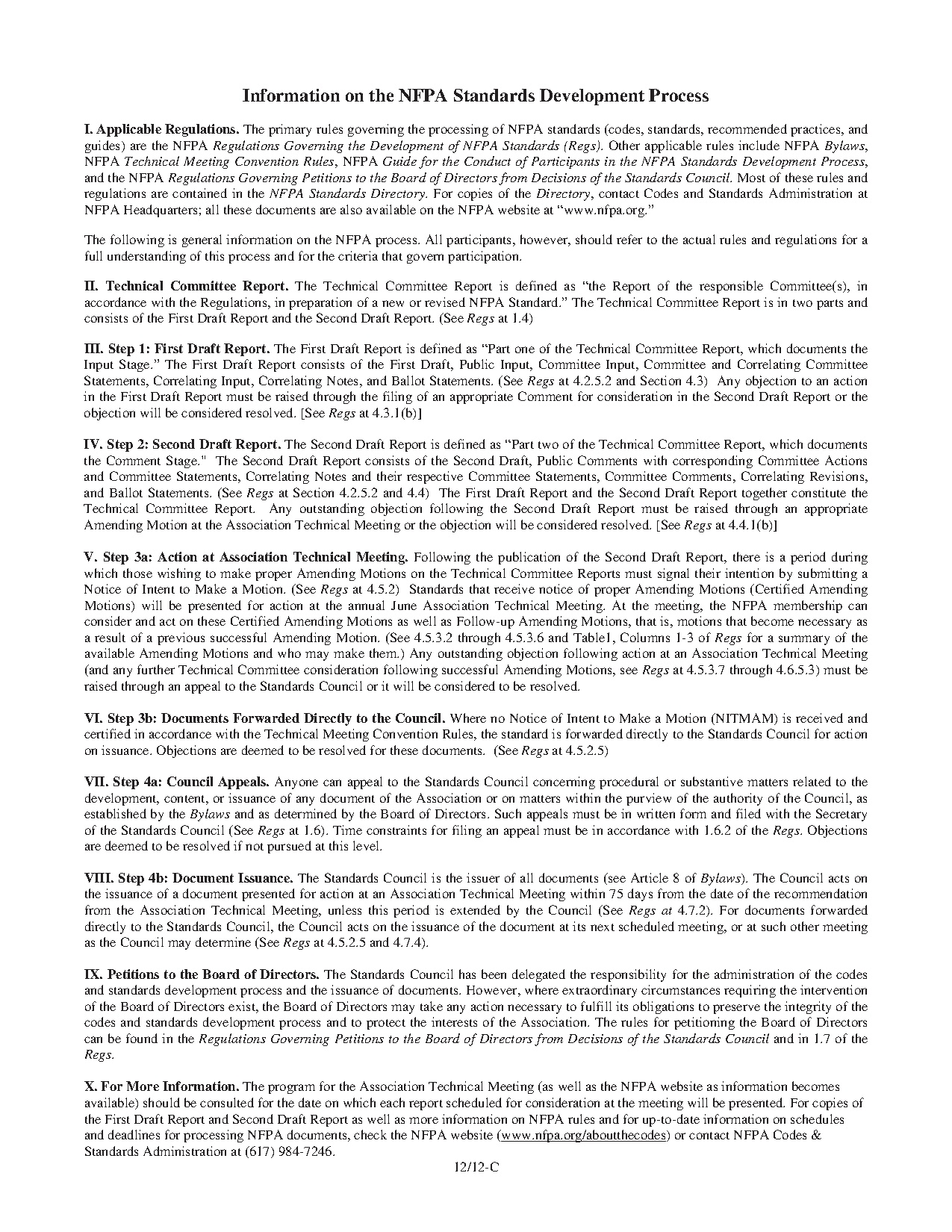
...action
in the First Draft Report must be raised through the filing of an appropriate Comment for consideration in the Second Draft Report or the
objection will be considered resolved. [See Regs at 4.3.1(b)]
IV. Step 2: Second Draft Report. The Second Draft Report is defined as “Part two of the Technical Committee Report, which documents
the Comment Stage." The Second Draft Report consists of the Second Draft, Public Comments with corresponding Committee Actions
and Committee Statements, Correlating Notes and their respective Committee Statements, Committee Comments, Correlating Revisions,
and Ballot Statements. (See Regs at Section 4.2.5.2 and 4.4) The First Draft Report and the Second Draft Report together constitute the
Technical Committee Report. Any outstanding objection following the Second Draft Report must be raised through an appropriate
Amending Motion at the Association Technical Meeting or the objection will be considered resolved. [See Regs at 4.4.1(b)]
V. Step 3a: Action at Association Technical Meeting. Following the publication of the Second Draft Report, there is a period during
which those wishing to make proper Amending Motions on the Technical Committee Reports must signal their intention by submitting a
Notice of Intent to Make a Motion. (See Regs at 4.5.2) Standards that receive notice of proper Amending Motions (Certified Amending
Motions) will be presented for action at the annual June Association Technical Meeting. At the meeting, the NFPA membership can
consider and act on these Certified Amending Motions as well as Follow-up Amending Motions, that is, motions that become necessary as
a result of a previous successful Amending Motion. (See 4.5.3.2 through 4.5.3.6 and Table1, Columns 1-3 of Regs for a summary of the
available Amending Motions and who may make them.) Any outstanding objection following action at an Association Technical Meeting
(and any further Technical Committee consideration following successful Amending Motions, see Regs at 4.5.3.7 through 4.6.5.3) must be
raised through an appeal to the Standards Council or it will be considered to be resolved.
73A0E5D7-EEC3-494A-BE71-9B790BC1BCCA
VI. Step 3b: Documents Forwarded Directly to the Council. Where no Notice of Intent to Make a Motion (NITMAM) is received and
certified in accordance with the Technical Meeting Convention Rules, the standard is forwarded directly to the Standards Council for action
on issuance. Objections are deemed to be resolved for these documents. (See Regs at 4.5.2.5)
VII. Step 4a: Council Appeals. Anyone can appeal to the Standards Council concerning procedural or substantive matters related to the
development, content, or issuance of any document of the Association or on matters within the purview of the authority of the Council, as
established by the Bylaws and as determined by the Board of Directors. Such appeals must be in written form and filed with the Secretary
of the Standards Council (See Regs at 1.6). Time constraints for filing an appeal must be in accordance with 1.6.2 of the Regs. Objections
are deemed to be resolved if not pursued at this level.
VIII. Step 4b: Document Issuance. The Standards Council is the issuer of all documents (see Article 8 of Bylaws). The Council acts on
the issuance of a document presented for action at an Association Technical Meeting within 75 days from the date of the recommendation
from the Association Technical Meeting, unless this period is extended by the Council (See Regs at 4.7.2). For documents forwarded
directly to the Standards Council, the Council acts on the issuance of the document at its next scheduled meeting, or at such other meeting
as the Council may determine (See Regs at 4.5.2.5 and 4.7.4).
IX. Petitions to the Board of Directors. The Standards Council has been delegated the responsibility for the administration of the codes
and standards development process and the issuance of documents. However, where extraordinary circumstances requiring the intervention
of the Board of Directors exist, the Board of Directors may take any action necessary to fulfill its obligations to preserve the integrity of the
codes and standards development process and to protect the interests of the Association. The rules for petitioning the Board of Directors
can be found in the Regulations Governing Petitions to the Board of Directors from Decisions of the Standards Council and in 1.7 of the
Regs.
X. For More Information. The program for the Association Technical Meeting (as well as the NFPA website as information becomes
available) should be consulted for the date on which each report scheduled for consideration at the meeting will be presented. For copies of
the First Draft Report and Second Draft Report as well as more information on NFPA rules and for up-to-date information on schedules
and deadlines for processing NFPA documents, check the NFPA website (www.nfpa.org/aboutthecodes) or contact NFPA Codes &
Standards Administration at (617) 984-7246.
12/12-C