Errata
NFPA 25
Standard for the Inspection, Testing, and Maintenance of
Water-Based Fire Protection Systems
2017 Edition
Reference: Various
Errata No: 25-17-1
The Technical Committee on Inspection, Testing, and Maintenance of Water-Based Protection
Systems notes the following errors in the 2017 edition of NFPA 25, Standard for the Inspection,
Testing, and Maintenance of Water-Based Fire Protection Systems.
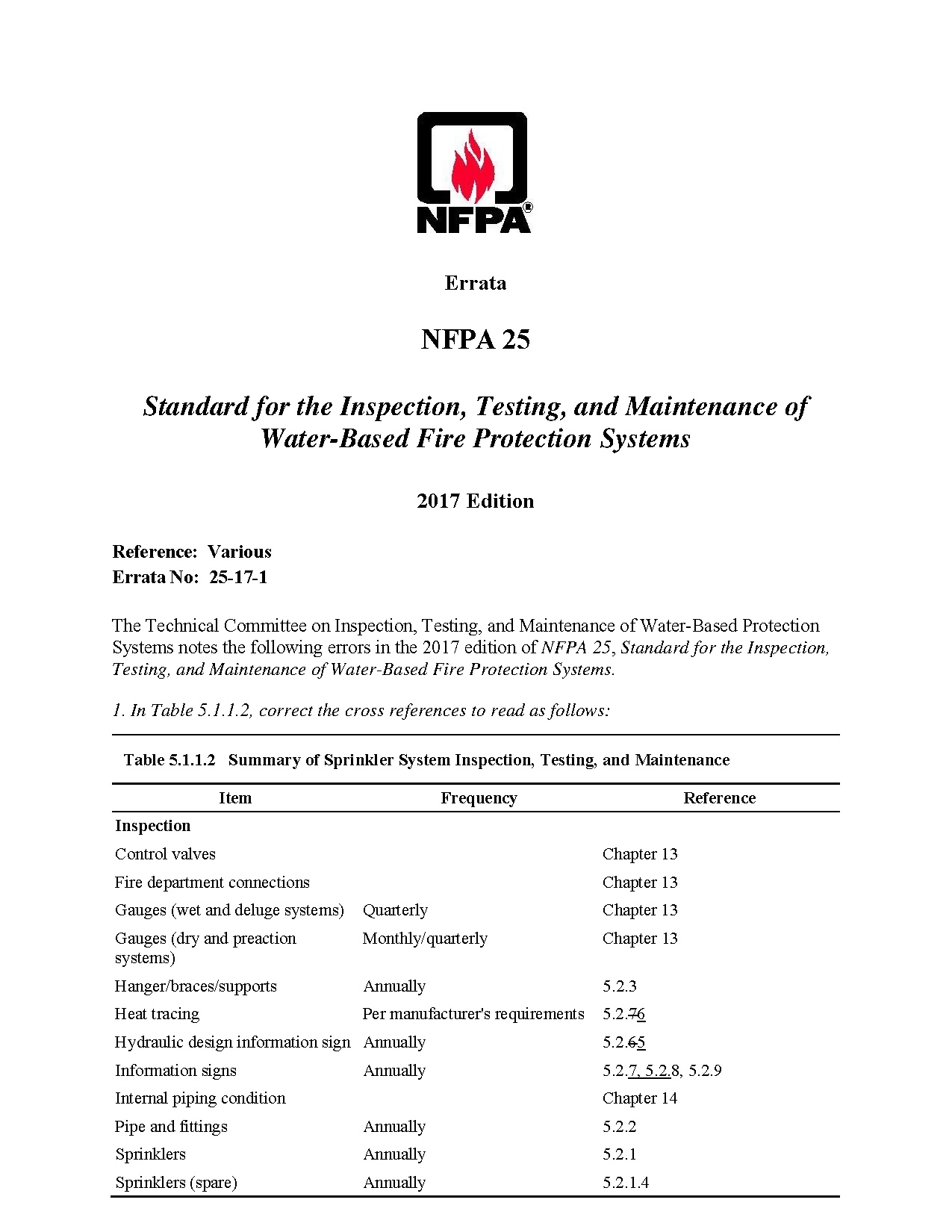
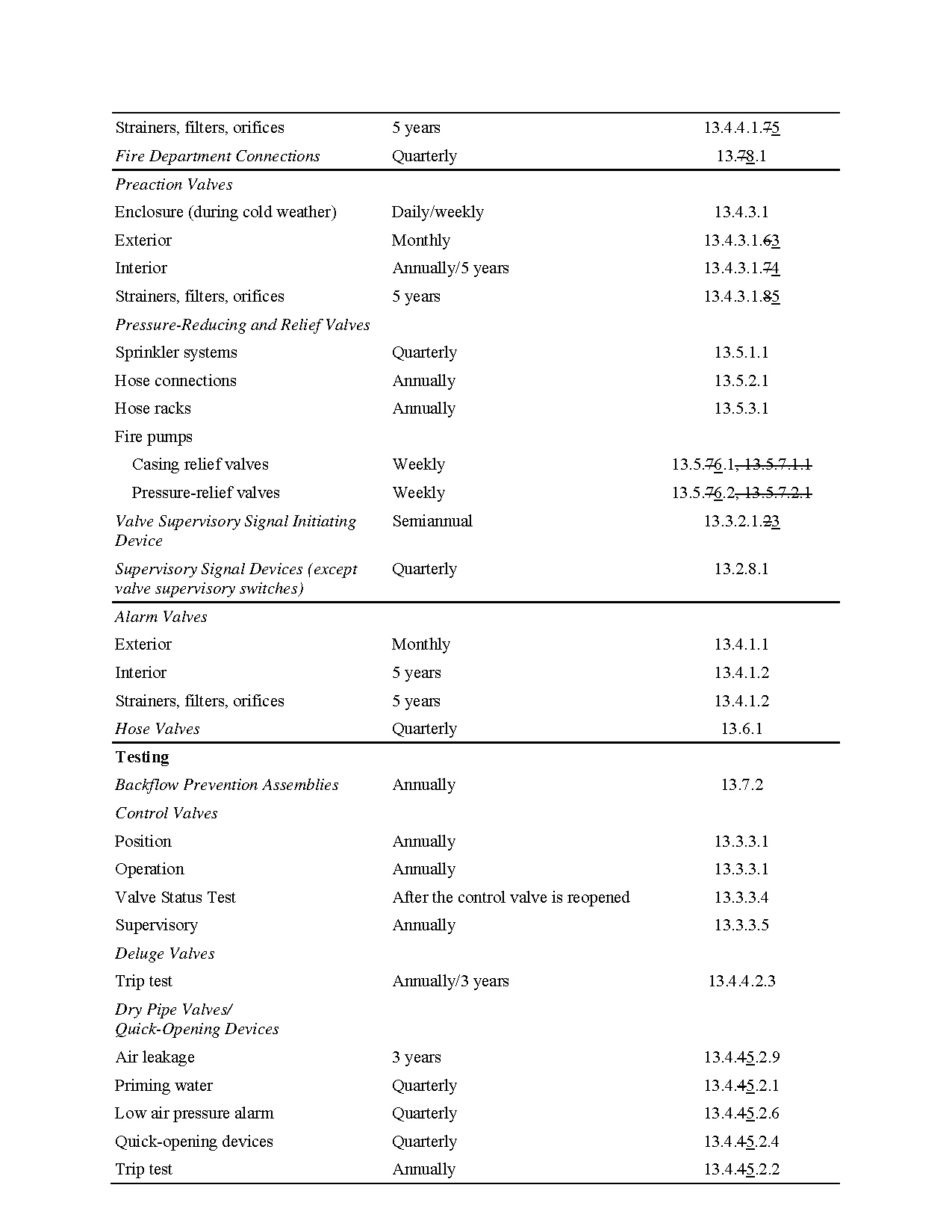
1. In Table 5.1.1.2, correct the cross references to read as follows:
Table 5.1.1.2 Summary of Sprinkler System Inspection, Testing, and Maintenance
Item
Frequency
Reference
Inspection
Control valves
Chapter 13
Fire department connections
Chapter 13
Gauges (wet and deluge systems)
Quarterly
Chapter 13
Gauges (dry and preaction
systems)
Monthly/quarterly
Chapter 13
Hanger/braces/supports
Annually
5.2.3
Heat tracing
Per manufacturer's requirements
5.2.76
Hydraulic design information sign Annually
5.2.65
Information signs
5.2.7, 5.2.8, 5.2.9
Annually
Internal piping condition
Chapter 14
Pipe and fittings
Annually
5.2.2
Sprinklers
Annually
5.2.1
Sprinklers (spare)
Annually
5.2.1.4
Supervisory signal devices (except Quarterly
valve supervisory switches)
5.2.54
System valves
Chapter 13
Valve supervisory signal devices
Quarterly
5.2.54
Waterflow alarm devices
Quarterly
5.2.54
Annually
5.3.43
Test
Antifreeze solution
Control valves
Gauges
Chapter 13
5 years
Main drain
Chapter 13
Chapter 13
Sprinklers
At 50 years and every 10 years
thereafter
5.3.1.1.1, 5.3.1.1.1.1, 5.3.1.1.1.2
Sprinklers
At 75 years and every 5 years
thereafter
5.3.1.1.1.5
Sprinklers (dry)
10 years and every 10 years
thereafter
5.3.1.1.1.6
Sprinklers (extra high or greater
temperature solder type)
5 years
5.3.1.1.1.4
Sprinklers (fast-response)
At 20 years and every 10 years
thereafter
5.3.1.1.1.3
Sprinklers (harsh environments)
5 years
5.3.1.1.2
Supervisory signal devices (except
valve supervisory switches)
Chapter 13
System valves
Chapter 13
Valve supervisory signal devices
Chapter 13
Waterflow alarm devices
(Mechanical)
Quarterly
5.3.32.1
Waterflow alarm devices (vane
and pressure switch type)
Semiannually
5.3.32.2
Maintenance
Low-point drains (dry pipe and
preaction systems)
Chapter 13
Annually
Sprinklers and automatic spray
nozzles protecting commercial
cooking equipment and ventilation
systems
5.4.1.7
Valves (all types)
Chapter 13
Investigation
Obstruction
Chapter 14
2. In Table 6.1.1.2, correct the cross references to read as follows:
Table 6.1.1.2 Summary of Standpipe and Hose Systems Inspection, Testing, and Maintenance
Item
Frequency
Reference
Inspection
Cabinet
Annually
Control valves
6.2.18
Chapter 13
Gauges
Weekly/quarterly
Chapter 13
Hose
Annually
NFPA 19626.2.5
Hose connection
Annually
6.2.13
Hose nozzle
Annually and after each use
NFPA 19626.2.6
Hose storage device
Annually
6.2.17
Hydraulic design information sign Annually
6.2.32
Hose valves
Chapter 13
Hose connection
Annually
6.2.1
Piping
Annually
6.2.14
Pressure-regulating devices
Chapter 13
Test
Flow test
5 years
6.3.1
Hose
5 years/3 years
NFPA 1962
Hose connections
Annually
6.2.1
Hose valves
Hydrostatic test
Chapter 13
5 years
6.3.2
Main drain test
Chapter 13
Pressure control valve
Chapter 13
Pressure-reducing valve
Chapter 13
Supervisory signal devices (except
valve supervisory switches)
Chapter 13
Valve status test
Chapter 13
Valve supervisory devices
Chapter 13
Waterflow alarm devices
Chapter 13
Maintenance
Hose connections
Annually
Hose valves
Valves (all types)
Table 6.1.2
Chapter 13
Annually/as needed
Chapter 13
3. Correct the cross references in 8.3.3.6.3.3 and 8.3.3.6.3.4 to read as follows:
8.3.3.6.3.3 If the test results are not consistent with the previous annual test, the test shall be
repeated using the test arrangement described in 8.3.3.6.3.1.
8.3.3.6.3.4 If testing in accordance with 8.3.3.6.3.1 is not possible, a flowmeter calibration
shall be performed and the test shall be repeated.
4. In Table 9.1.1.2, correct the cross references to read as follows:
Table 9.1.1.2 Summary of Water Storage Tank Inspection, Testing, and Maintenance
Item
Frequency
Reference
Inspection
Air pressure—tanks that have their air pressure
source supervised
Quarterly
9.2.2.1
Air pressure—tanks without their air pressure
source supervised
Monthly
9.2.2.2
Catwalks and ladders
Quarterly
9.2.54.1
Check valves
Chapter 13
Control valves
Chapter 13
Expansion joints
Annually
9.2.54.3
Heating system — tanks with supervised low
temperature alarms connected to constantly
attended location
Weekly*
9.2.32.1
Heating system — tanks without supervised low
temperature alarms connected to constantly
attended location
Daily*
9.2.32.2
Hoops and grillage
Annually
9.2.54.4
Interior — all other tanks
5 years
9.2.65.1.2
Interior — steel tanks without corrosion
protection
3 years
9.2.65.1.1
Painted/coated surfaces
Annua
...
--------------------------------------
...temperature
13.4.3.1.1,
13.4.4.1.1
X
Valve enclosure
Low
temperature
alarms (if
installed) are
physically
damaged
13.4.3.1.1,
13.4.4.1.1
X
13.4.3.1.63, 13.4.4.1.3
X
Preaction valve and deluge External
valve
physical
damage, trim
valves not in
X
X
X
X
appropriate
open or closed
position, valve
seat leaking
Preaction valve and deluge Electrical
valve
components
not in service
13.4.3.1.63, 13.4.4.1.3
X
Dry pipe valve/quickopening device
13.4.4.1.45.1.3
External
physical
damage, trim
valves not in
appropriate
open or closed
position,
intermediate
chamber
leaking
Sprinkler pressurereducing control valves
Not in open
position
13.5.1.1
Sprinkler pressurereducing control valves
Not
maintaining
downstream
pressures in
accordance
with design
criteria
13.5.1.1
X
Sprinkler pressurereducing control valves
Leaking, valve 13.5.1.1
damaged,
hand wheel
missing or
broken
X
13.5.2.1
Hose connection pressure- Hand wheel
reducing valves
broken or
missing, hose
threads
damaged,
leaking,
reducer
missing
X
X
X
Hose connection pressure- Cap missing
reducing valves
13.5.2.1
X
Hose rack assembly
pressure-reducing valve
Hand wheel
broken or
missing,
leaking
13.5.3.1
X
Hose valves
13.56.6.1
Leaking,
visible
obstructions,
caps, hose
threads, valve
X
handle, cap
gasket, no
restricting
device,
damaged, or in
poor condition
Hose valves
Hose threads 13.56.6.1
not compatible
Backflow prevention
assemblies
13.67.1.21
Reducedpressure
assemblies,
differentialsensing valve
relief port
continuously
discharging
Fire department
connection
Not
accessible,
damaged
couplings, or
clapper not
operating
properly or
missing
Fire department
connection
Couplings and 13.78.1
swivels
damaged, do
not rotate
smoothly,
check valve
leaking,
automatic
drain not
operating
properly or
missing
Fire department
connection
Missing
identification
sign
13.78.1
X
X
X
X
13.78.1
X
Chapter 13: Valves, Valve Components,
and Trim — Testing
Main drain
More than
10% drop in
full flow
pressure
13.2.5.23
X
Alarm devices
Water motor
and gong not
functioning
13.2.6.1
X
Alarm devices
Pressure
switch or
13.2.6.2
X
vane-type
switch not
functioning,
no alarm
Gauges
Not replaced 13.2.7.2,
or calibrated 13.2.7.3
in 5 years, not
accurate
within 3% of
scale
Control valve
13.3.3.1
Valve not
operating
through its full
range
Control valve
No spring or 13.3.3.2
torsion felt in
rod when
opening post
indicator valve
Supervisory switches
13.3.3.5.2
No signal
from two
revolutions of
hand wheel
from normal
position or
when stem has
moved onefifth of
distance from
normal
position,
signal restored
in position
other than
normal
X
Preaction valve
Priming water 13.4.3.2.1
level not
correct
X
Preaction valve
13.4.4.23.2.2
Pressure
reading at
hydraulically
most remote
nozzle and/or
at valve not
comparable to
original design
values
X
Preaction valve
Three-year
leakage test
failed
X
13.4.3.2.65
X
X
X
13.4.3.24.2.3
Deluge valve
Annual full
flow trip test
revealed
plugged
nozzles,
manual
actuation
devices did
not operate
properly
Deluge valve
13.4.3.24.2.3
Pressure
reading at
hydraulically
most remote
nozzle and/or
at valve not
compatible
with original
design values
X
Preaction valve
13.4.3.2.1210
Low air
pressure
switch did not
send signal, no
alarm
X
13.4.3.2.11,
Preaction and deluge valve Low
13.4.4.2.14
temperature
switch did not
send signal, no
alarm
X
X
X
Preaction valve
Automatic air 13.4.3.2.1412
maintenance
device did not
pass test
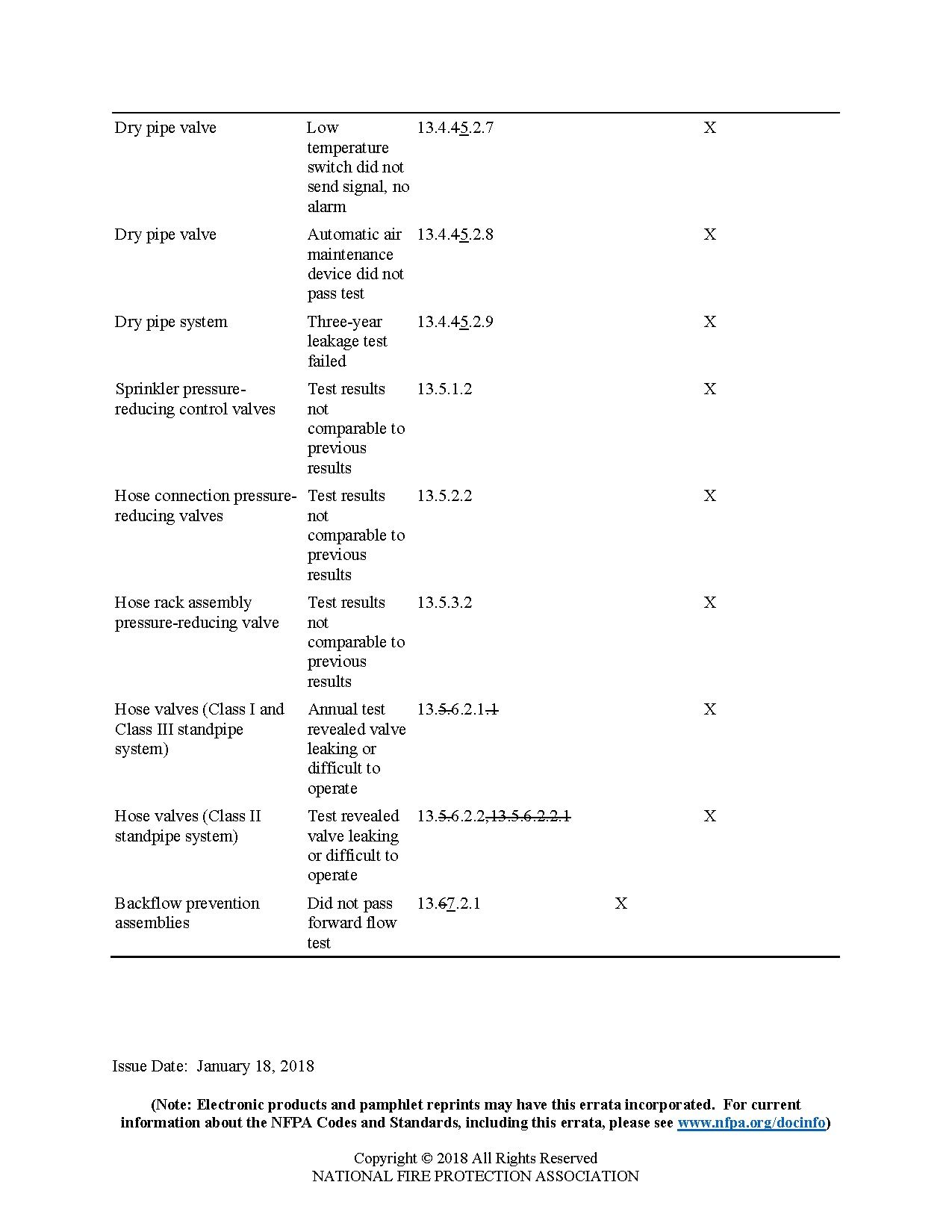
Dry pipe valve
Priming water 13.4.45.2.1
level not
correct
X
Dry pipe valve
13.4.45.2.2.2
Test results
not
comparable
with previous
results
X
Quick-opening device
Quick-opening 13.4.45.2.4
device did not
pass test
X
Dry pipe valve
Low air
13.4.45.2.6
pressure
switch did not
send signal, no
alarm
X
Dry pipe valve
Low
13.4.45.2.7
temperature
switch did not
send signal, no
alarm
X
Dry pipe valve
Automatic air 13.4.45.2.8
maintenance
device did not
pass test
X
Dry pipe system
Three-year
leakage test
failed
X
Sprinkler pressurereducing control valves
Test results
13.5.1.2
not
comparable to
previous
results
X
Hose connection pressure- Test results
13.5.2.2
reducing valves
not
comparable to
previous
results
X
Hose rack assembly
pressure-reducing valve
Test results
13.5.3.2
not
comparable to
previous
results
X
Hose valves (Class I and
Class III standpipe
system)
13.5.6.2.1.1
Annual test
revealed valve
leaking or
difficult to
operate
X
Hose valves (Class II
standpipe system)
Test revealed
valve leaking
or difficult to
operate
13.5.6.2.2,13.5.6.2.2.1
Backflow prevention
assemblies
Did not pass
forward flow
test
13.67.2.1
13.4.45.2.9
X
X
Issue Date: January 18, 2018
(Note: Electronic products and pamphlet reprints may have this errata incorporated. For current
information about the NFPA Codes and Standards, including this errata, please see www.nfpa.org/docinfo)
Copyright © 2018 All Rights Reserved
NATIONAL FIRE PROTECTION ASSOCIATION