SAFETY SECURITY CONTROL SYSTEM
SPRINKLER SUPPRESSION SYSTEM
GROUP NO. 1
Lecturer: Asoc. Prof. Dr. Quyen Huy Anh
Student:
Hoang Duy
Nguyen Thanh Phat
Le Trong Tinh
ID
22135004
22135032
22135041
TABLE OF CONTENTS
1. INTRODUCTION
2. SYSTEM CLASSIFICATION
3. SPRINKLER HEADS
4. PIPING NETWORK
5. OTHER COMPONENTS
6. FIRE DEPARTMENT CONNECTIONS (FDC)
7. ESTIMATION
8. SPRINKLER SUPPRESSION SYSTEM DESIGN
01
INTRODUCTION
To Fire Sprinkler System
1. INTRODUCTION TO FIRE SPRINKLER SYSTEM
1.1. What’s a Sprinkler System ?
❖ A fire sprinkler system is an ACTIVE fire protection
measure, designed to ensure adequate water pressure and
flow through a distribution network, with sprinklers
strategically connected to provide coverage.
❖ Since their introduction in the late 1880s, sprinkler systems
have continuously evolved, adapting to advancements in
fire safety and engineering to maximize efficiency.
❖ Today, they serve as a crucial safeguard for industrial,
commercial, and residential buildings, significantly
reducing fire damage and casualties worldwide.
Figure 1.1.1. Generic Sprinkler Head
1. INTRODUCTION TO FIRE SPRINKLER SYSTEM
1.2. Sprinkler System Components
A typical sprinkler system consists of the following components:
▪
Sprinklers;
▪
Pipes & Fittings;
▪
Accessories (Control Valves, Alarms, etc);
▪
Pump System;
▪
Control Panel.
Figure 1.1.1. Generic Sprinkler Head
1. INTRODUCTION TO FIRE SPRINKLER SYSTEM
1.3. Techincal Requirements
Some requirements for a typical sprinkler system:
❖ Control Rate: The system must be capable of controlling or
extinguishing a fire within a specific area to prevent further
spread;
❖ Response Time: Sprinklers should activate within seconds of
detecting heat (Typically around 57°C – 74°C);
❖ Minimum Pressure: Typically ranges from 48–138 kPa;
❖ Backup Water Source: In case of primary failure, alternative water
sources should be available.
Figure 1.3.1. Generic Sprinkler Head
1. INTRODUCTION TO FIRE SPRINKLER SYSTEM
1.3. Techincal Requirements
Some requirements for a typical sprinkler system:
❖ Pipe Materials: Should be made of steel, copper to withstand
high temperatures;
❖ Sprinkler Heads: Must be corrosion-resistant and rated for the
specific fire risk;
❖ Temperature Control: Sprinklers should be installed in areas
where temperatures do not drop below freezing unless using
antifreeze solutions;
❖ Clearance Requirements: Ensure at least 45 cm of clearance
below sprinkler heads.
Figure 1.3.1. Generic Sprinkler Head
1. INTRODUCTION TO FIRE SPRINKLER SYSTEM
1.4. The Design
❑ Sprinkler suppression systems are designed in accordance
with NFPA 13, QCVN 06:2022/BXD, and TCVN 7336:2021
standards.
❑ There are two ways to design a sprinkler system:
▪
Pipe Schedule: Based on predetermined pipe sizes
and layouts;
▪
Hydraulically Calculated: Uses calculations to
determine pipe sizes based on required water flow and
pressure;
▪
Chapter 8 will go deeper into these methods.
Figure 1.4.1. Common code & standard
02
SYSTEM CLASSIFICATION
2. SYSTEM CLASSIFICATION
2.1. Category
There are four major types of sprinkler system:
Sprinkler System Type
Installed where
1
Wet Pipe System
Occupancies with temperature 95oC > X > 0oC, used the most.
2
Dry Pipe System
Occupancies with risk of temperature X < 0oC and X > 95oC
3
Deluge system
Occupancies with rapid fire spread
4
Protection pipe systems
Where water damage is not accepted by accidental activation
2. SYSTEM CLASSIFICATION
2.2. Wet Pipe System
02
01
Most Reliable
Widely Installed
Characteristics
04
Simple
03
Requires little
maintenance
2. SYSTEM CLASSIFICATION
2.2. Wet Pipe System
❑ Heat from fire causes the sprinkler head to break open,
releasing water;
❑ Water continues flowing until manually shut off;
❑ Once the fire is controlled, the activated sprinkler head
must be replaced, and the system reset to restore
readiness for future incidents;
❑ A control valve allows manual shutdown to prevent
excess water discharge and enable maintenance.
Figure 2.2.1. Components of the wet system
2. SYSTEM CLASSIFICATION
2.2. Wet Pipe System
❑ A check valve (one-way clapper) prevents water from
re-entering the water supply;
❑ Gauges on both sides of the valve measure supply and
system pressure. A retard chamber absorbs pressure
surges to prevent false alarms in the system;
❑ An alarm check valve detects water flow and activates
the alarm system;
❑ A Main Drain Valve which drains the system for service.
Figure 2.2.1. Components of the wet system
2. SYSTEM CLASSIFICATION
2.2. Wet Pipe System
❑ An Inspector's Test Valve is typically located
at the end of the sprinkler system to assess
functionality;
❑ It simulates water flow from a single sprinkler
head, allowing measurement of response
time;
❑ It ensures proper alarm activation and water
supply performance for routine maintenance
and compliance.
Figure 2.2.2. Inspectors test valve position
2. SYSTEM CLASSIFICATION
2.3. Dry Pipe System
❑ Pipes are
...
--------------------------------------
... SPRINKLER SUPPRESSION SYSTEM DESIGN
❑ The following system is designed in according to Daniel Bernoulli
????=
????????
????????
D: Sprinkler pipe diameter (????????)
Q: Sprinkler discharge flow (L/min)
V: Sprinkler flow velocity (????/????) with ???? = 10 (????/????) according to B2.4, TCVN 7336:2021
8. SPRINKLER SUPPRESSION SYSTEM DESIGN
❑ Pipe friction loss of sprinkler piping system is calculated according to the following equations
❖ A: Darcy – Weisbach:
❖ Steel pipe:
????: Slope
λ: Friction coefficient
D: Inside diameter (m)
V: Water velocity (m/s)
L: Pipe length (m)
❖ Cast iron pipe:
8. SPRINKLER SUPPRESSION SYSTEM DESIGN
❑ Pipe friction loss of sprinkler piping system is calculated according to the following equations
❖ B: Hazen – Williams:
❖ C: Manning
D: Inside diameter (m)
L: Pipe length (m)
Q: Pipe flow (m3 /s)
CHW : Hazen – Williams coefficient
n: Manning coefficient
8. SPRINKLER SUPPRESSION SYSTEM DESIGN
❑ The local head loss is calculated in accordance with TCVN 7336:2021:
8. SPRINKLER SUPPRESSION SYSTEM DESIGN
❑ The fire alarm head loss is calculated in accordance with TCVN 7336:2021:
8. SPRINKLER SUPPRESSION SYSTEM DESIGN
❑ Sprinkler configuration in accordance with QCVN 06:
❖ QCVN 06-2020:
❖ QCVN 06-2022:
8. SPRINKLER SUPPRESSION SYSTEM DESIGN
❑ The number of sprinklers is in accordance with TCVN 7336:2021, as shown in the following table:
8. SPRINKLER SUPPRESSION SYSTEM DESIGN
❑ The distances of sprinklers is in accordance with TCVN 7336:2021:
8. SPRINKLER SUPPRESSION SYSTEM DESIGN
8. SPRINKLER SUPPRESSION SYSTEM DESIGN
❑ with NFPA13-2022:
8. SPRINKLER SUPPRESSION SYSTEM DESIGN
❑ with NFPA13-2022:
8. SPRINKLER SUPPRESSION SYSTEM DESIGN
❑ with NFPA13-2022:
8. SPRINKLER SUPPRESSION SYSTEM DESIGN
❑ The distances of sprinklers is in accordance with NFPA13-2022:
8. SPRINKLER SUPPRESSION SYSTEM DESIGN
❑ The distances of sprinklers is in accordance with NFPA13-2022:
8. SPRINKLER SUPPRESSION SYSTEM DESIGN
❑ with NFPA13-2022:
8. SPRINKLER SUPPRESSION SYSTEM DESIGN
❑ Return bends are in according with NFPA13-2022:
8. SPRINKLER SUPPRESSION SYSTEM DESIGN
❑ The distances of sprinklers is in accordance with NFPA13-2022:
8. SPRINKLER SUPPRESSION SYSTEM DESIGN
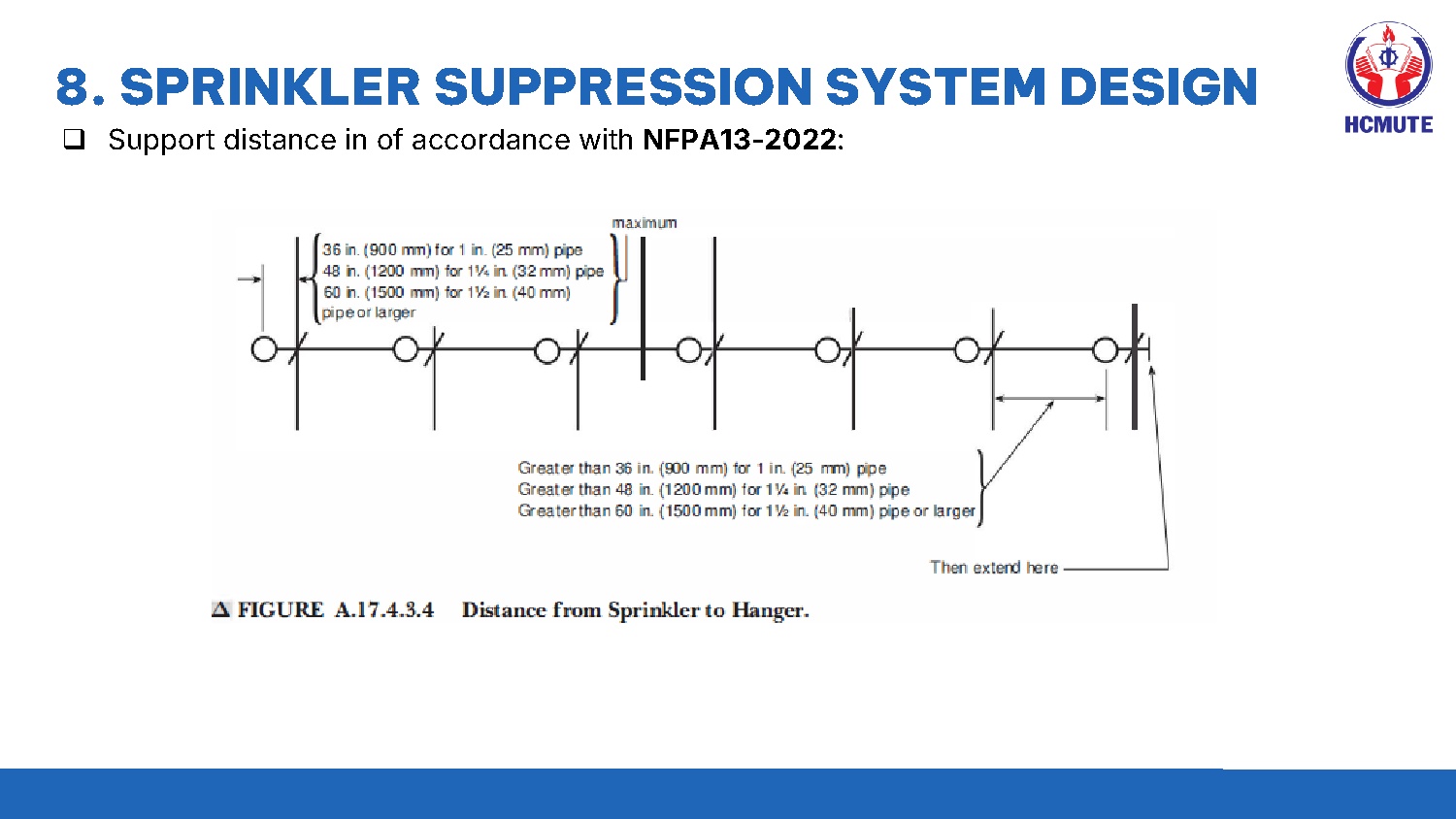
❑ Support distance in of accordance with NFPA13-2022:
8. SPRINKLER SUPPRESSION SYSTEM DESIGN
❑ Support distance in of accordance with NFPA13-2022:
8. SPRINKLER SUPPRESSION SYSTEM DESIGN
❑ Support distance in of accordance with NFPA13-2022:
8. SPRINKLER SUPPRESSION SYSTEM DESIGN
❑ Support distance in of accordance with NFPA13-2022:
8. SPRINKLER SUPPRESSION SYSTEM DESIGN
❑ The distances of sprinklers is in accordance with NFPA13-2022:
8. SPRINKLER SUPPRESSION SYSTEM DESIGN
❑ Example of Dead-end network calculation:
8. SPRINKLER SUPPRESSION SYSTEM DESIGN
❑ Head loss between two nodes at different elevations:
8. SPRINKLER SUPPRESSION SYSTEM DESIGN
❑ Pipe sizes is in according with TCVN 7336:2021, as shown in the following table:
8. SPRINKLER SUPPRESSION SYSTEM DESIGN
6m
❑ Example: Hydraulic calculation of the following
dead-end fire-fighting network:
qmin = 1.5 (L/s)
CHW = 120
Ignore local head loss. Using Hazen – Williams
equation to calculate the pipe friction loss.
4.5m
➢ Given: K = 80.6 (LPM/bar 0.5 )
6m
8. SPRINKLER SUPPRESSION SYSTEM DESIGN
8. SPRINKLER SUPPRESSION SYSTEM DESIGN
8. SPRINKLER SUPPRESSION SYSTEM DESIGN
8. SPRINKLER SUPPRESSION SYSTEM DESIGN
8. SPRINKLER SUPPRESSION SYSTEM DESIGN
8. SPRINKLER SUPPRESSION SYSTEM DESIGN
8. SPRINKLER SUPPRESSION SYSTEM DESIGN
8. SPRINKLER SUPPRESSION SYSTEM DESIGN
•
Loop 6
8. SPRINKLER SUPPRESSION SYSTEM DESIGN
8. SPRINKLER SUPPRESSION SYSTEM DESIGN
8. SPRINKLER SUPPRESSION SYSTEM DESIGN
INPUT
8. SPRINKLER SUPPRESSION SYSTEM DESIGN
K=Q/ ????
8. SPRINKLER SUPPRESSION SYSTEM DESIGN
8. SPRINKLER SUPPRESSION SYSTEM DESIGN
INPUT
COMPARISION
VS
REFERENCES
LINK:
https://canutesoft.com/hydraulic-calculation-for-fire-protection-engineers/how-tocalculate-a-fire-sprinkler-system
REFERENCES
[1] Lê Đức Thường, Huỳnh Thị Lan Hương, Nguyễn Văn Hồng (2022).
Hệ Thống Chữa Cháy Công Trình. NXB Xây Dựng
[2] National Fire Protection Association (2022).
NFPA 13 - Standard for the Installation of Sprinkler Systems
[3] National Fire Protection Association (2024).
NFPA 1 – Fire Code
[4] Guy R. Grant, PE (2018).
Fire Sprinkler Systems. University of Illinois
[5] British Standard (2020).
Fire sprinkler systems for domestic and residential occupancies.
REFERENCES
[6] Bộ Xây Dựng (2022).
QCVN 06:2022/BXD – Quy chuẩn kỹ thuật quốc gia về an toàn cháy cho nhà và công trình.
[7] Tiêu chuẩn Việt Nam (2021).
TCVN 7336:2021 - Quy định đối với việc thiết kế, lắp đặt hệ thống chữa cháy tự động bằng
nước, bọt cho nhà và công trình
[6] Singapore Standard (2004).
Code of Practice for Automatic fire sprinkler system.
THANKS FOR
LISTENING!
CREDITS: This presentation template was created by Slidesgo, and
includes icons by Flaticon, and infographics & images by Freepik