ANSI/ASHRAE Standard 62.1-2010
(Supersedes ANSI/ASHRAE Standard 62.1-2007)
Includes ANSI/ASHRAE addenda listed in Appendix J
ASHRAE STANDARD
Ventilation
for Acceptable
Indoor Air Quality
See Appendix J for approval dates by the ASHRAE Standards Committee the ASHRAE Board of Directors,
and the American National Standards Institute.
This standard is under continuous maintenance by a Standing Standard Project Committee (SSPC) for which
the Standards Committee has established a documented program for regular publication of addenda or revisions, including procedures for timely, documented, consensus action on requests for change to any part of
the standard. The change submittal form, instructions, and deadlines may be obtained in electronic form from
the ASHRAE Web site (www.ashrae.org) or in paper form from the Manager of Standards. The latest edition of
an ASHRAE Standard may be purchased from the ASHRAE Web site (www.ashrae.org) or from ASHRAE
Customer Service, 1791 Tullie Circle, NE, Atlanta, GA 30329-2305. E-mail:
[email protected]. Fax: 404321-5478. Telephone: 404-636-8400 (worldwide), or toll free 1-800-527-4723 (for orders in US and Canada).
For reprint permission, go to www.ashrae.org/permissions.
© Copyright 2010 American Society of Heating, Refrigerating and Air-Conditioning Engineers, Inc.
ISSN 1041-2336
American Society of Heating, Refrigerating
and Air-Conditioning Engineers, Inc.
1791 Tullie Circle NE, Atlanta, GA 30329
www.ashrae.org
© American Society of Heating, Refrigerating and Air-Conditioning Engineers, Inc. (www.ashrae.org). For personal use only.
Additional reproduction, distribution, or transmission in either print or digital form is not permitted without ASHRAE’s prior written permission.
ASHRAE Standing Standard Project Committee 62.1
Cognizant TC: TC 4.3, Ventilation Requirements and Infiltration
SPLS Liaison: Robert G. Baker
Staff Liaison: Mark Weber
Roger L. Hedrick, Chair
John K. McFarland, Vice-Chair
Dennis A. Stanke, Chair (2007–2009)
Leon E. Alevantis
Michael G. Apte
David C. Bixby
Hoy R. Bohanon, Jr.
Gregory Brunner
Mark P. Buttner
Waller S. Clements
David R. Conover
Leonard A. Damiano
Richard A. Danks
Francis J. Fisher, Jr.
Vincent T. Galatro
Francis Michael Gallo
John R. Girman
Diane I. Green
Donald C. Herrmann
Thomas P. Houston
Eli P. Howard, III
Roger L. Howard
Wayne M. Lawton
Don MacMillan
Chris R. Magee
Carl A. Marbery
James Patrick McClendon
Adam S. Muliawan
Christopher O. Muller
Darren B. Meyers
Lisa J. Rogers
Duane P. Rothstein
Lawrence J. Schoen
Chandra Sekhar
Harris M. Sheinman
Dennis M. Siano
Jeffrey K. Smith
Anthony J. Spata
Christine Q. Sun
Jan Sundell
Wayne R. Thomann
Dilip Y. Vyavaharkar
Michael W. Woodford
ASHRAE STANDARDS COMMITTEE 2009–2010
Steven T. Bushby, Chair
H. Michael Newman, Vice-Chair
Douglass S. Abramson
Robert G. Baker
Michael F. Beda
Hoy R. Bohanon, Jr.
Kenneth W. Cooper
K. William Dean
Martin Dieryckx
Allan B. Fraser
Nadar R. Jayaraman
Byron W. Jones
Jay A. Kohler
Carol E. Marriott
Merle F. McBride
Frank Myers
Janice C. Peterson
Douglas T. Reindl
Lawrence J. Schoen
Boggarm S. Setty
Bodh R. Subherwal
James R. Tauby
James K. Vallort
William F. Walter
Michael W. Woodford
Craig P. Wray
Wayne R. Reedy, BOD ExO
Thomas E. Watson, CO
Stephanie Reiniche, Manager of Standards
SPECIAL NOTE
This American National Standard (ANS) is a national voluntary consensus standard developed under the auspices of the American
Society of Heating, Refrigerating and Air-Conditioning Engineers (ASHRAE). Consensus is defined by the American National Standards
Institute (ANSI), of which ASHRAE is a member and which has approved this standard as an ANS, as “substantial agreement reached by
directly and materially affected interest categories. This signifies the concurrence of more than a simple majority, but not necessarily unanimity.
Consensus requires that all views and objections be considered, and that an effort be made toward their resolution.” Compliance with this
standard is voluntary until and unless a legal jurisdiction makes compliance mandatory through legislation.
ASHRAE obtains consensus through participation of its national and international members, associated societies, and public review.
ASHRAE Standards are prepared by a Project Committee appointed specifically for the purpose of writing the Standard. The Project
Committee Chair and Vice-Chair must be members of ASHRAE; while other committee members may or may not be ASHRAE members, all
must be technically qualified in the subject area of the Standard. Every effort is made to balance the concerned interests on all Project
Committees.
The Manager of Standards of ASHRAE should be contacted for:
a. interpretation of the contents of this Standard,
b. participation in the next review of the Standard,
c. offering constructive criticism for improving the Standard, or
d. permission to reprint portions of the Standard.
DISCLAIMER
ASHRAE uses its best efforts to promulgate Standards and Guidelines for the
...
--------------------------------------
...-Conditioning Engineers (ASHRAE) the non-exclusive royalty rights,
including non-exclusive rights in copyright, in my proposals. I understand that I acquire no rights in publication of the standard in which my proposals in this or other analogous form is used. I hereby attest that I have the authority and am empowered to grant this copyright release.
2. Number and year of standard:
3. Page number and clause (section), subclause, or paragraph number:
4. I propose to:
(check one)
[ ] Change to read as follows
[ ] Add new text as follows
[ ] Delete and substitute as follows
[ ] Delete without substitution
Use underscores to show material to be added (added) and strike through material to be deleted (deleted). Use additional pages if needed.
5. Proposed change:
6. Reason and substantiation:
7. Will the proposed change increase the cost of engineering or construction? If yes, provide a brief explanation as
to why the increase is justified.
[ ] Check if additional pages are attached. Number of additional pages: _______
[ ] Check if attachments or referenced materials cited in this proposal accompany this proposed change. Please verify that all
attachments and references are relevant, current, and clearly labeled to avoid processing and review delays. Please list your
attachments here:
Rev. 3-9-2007
POLICY STATEMENT DEFINING ASHRAE’S CONCERN
FOR THE ENVIRONMENTAL IMPACT OF ITS ACTIVITIES
ASHRAE is concerned with the impact of its members’ activities on both the indoor and outdoor environment. ASHRAE’s
members will strive to minimize any possible deleterious effect on the indoor and outdoor environment of the systems and
components in their responsibility while maximizing the beneficial effects these systems provide, consistent with accepted
standards and the practical state of the art.
ASHRAE’s short-range goal is to ensure that the systems and components within its scope do not impact the indoor and
outdoor environment to a greater extent than specified by the standards and guidelines as established by itself and other
responsible bodies.
As an ongoing goal, ASHRAE will, through its Standards Committee and extensive technical committee structure,
continue to generate up-to-date standards and guidelines where appropriate and adopt, recommend, and promote those new
and revised standards developed by other responsible organizations.
Through its Handbook, appropriate chapters will contain up-to-date standards and design considerations as the material is
systematically revised.
ASHRAE will take the lead with respect to dissemination of environmental information of its primary interest and will seek
out and disseminate information from other responsible organizations that is pertinent, as guides to updating standards and
guidelines.
The effects of the design and selection of equipment and systems will be considered within the scope of the system’s
intended use and expected misuse. The disposal of hazardous materials, if any, will also be considered.
ASHRAE’s primary concern for environmental impact will be at the site where equipment within ASHRAE’s scope
operates. However, energy source selection and the possible environmental impact due to the energy source and energy
transportation will be considered where possible. Recommendations concerning energy source selection should be made by
its members.
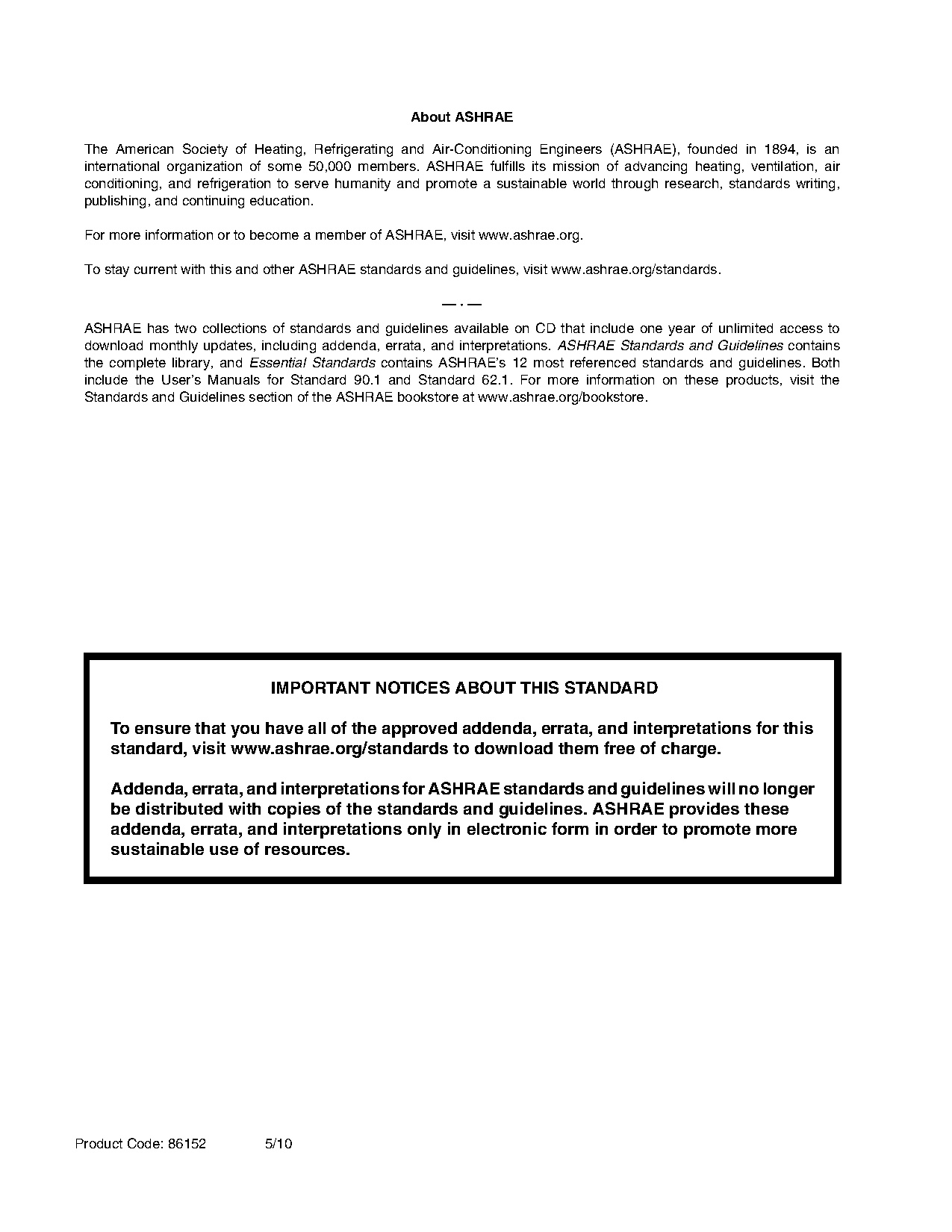
About ASHRAE
The American Society of Heating, Refrigerating and Air-Conditioning Engineers (ASHRAE), founded in 1894, is an
international organization of some 50,000 members. ASHRAE fulfills its mission of advancing heating, ventilation, air
conditioning, and refrigeration to serve humanity and promote a sustainable world through research, standards writing,
publishing, and continuing education.
For more information or to become a member of ASHRAE, visit www.ashrae.org.
To stay current with this and other ASHRAE standards and guidelines, visit www.ashrae.org/standards.
—·—
ASHRAE has two collections of standards and guidelines available on CD that include one year of unlimited access to
download monthly updates, including addenda, errata, and interpretations. ASHRAE Standards and Guidelines contains
the complete library, and Essential Standards contains ASHRAE’s 12 most referenced standards and guidelines. Both
include the User’s Manuals for Standard 90.1 and Standard 62.1. For more information on these products, visit the
Standards and Guidelines section of the ASHRAE bookstore at www.ashrae.org/bookstore.
IMPORTANT NOTICES ABOUT THIS STANDARD
To ensure that you have all of the approved addenda, errata, and interpretations for this
standard, visit www.ashrae.org/standards to download them free of charge.
Addenda, errata, and interpretations for ASHRAE standards and guidelines will no longer
be distributed with copies of the standards and guidelines. ASHRAE provides these
addenda, errata, and interpretations only in electronic form in order to promote more
sustainable use of resources.
Product Code: 86152
5/10