Peking University Linguistics Research 1
Ping Ke
Contrastive
Linguistics
Peking University Linguistics Research
Volume 1
Peking University Linguistics Research (PKULR) is a cooperation project between
Springer Nature and Peking University Press. This series presents the latest
discoveries and developments of significance in linguistic research conducted by
famous Chinese scholars. Titles in this series are carefully evaluated, examined and
selected by Peking University (which ranks No. 10 in the world and No. 1 in China
in the QS World University Rankings-Linguistics 2016) and Peking University
Press (which was honored as the most influential publisher in linguistics according
to Chinese Book Citation Index, 2016), covering all major aspects of linguistics—
phonetics, phonology, pragmatics, semantics, morphology, syntax, theoretical
linguistics, applied linguistics and inter-disciplinary studies. PKULR aims to
provide an invaluable guide to the very nature of language. On the one hand, it tries
to offer a thorough grounding in the fundamental concepts of linguistics; on the
other hand, it also attaches great importance to the practical application of these
concepts, esp. in Chinese context.
More information about this series at http://www.springer.com/series/15701
Ping Ke
Contrastive Linguistics
123
Ping Ke
Department of English
Nanjing University
Nanjing, Jiangsu, China
ISSN 2524-6119
ISSN 2524-6127 (electronic)
Peking University Linguistics Research
ISBN 978-981-13-1384-4
ISBN 978-981-13-1385-1 (eBook)
https://doi.org/10.1007/978-981-13-1385-1
Jointly published with Peking University Press, Beijing, China
The printed edition is not for sale in the Mainland of China. Customers from the Mainland of China
please order the print book from Peking University Press.
Library of Congress Control Number: 2018950194
© Peking University Press and Springer Nature Singapore Pte Ltd. 2019
This work is subject to copyright. All rights are reserved by the Publishers, whether the whole or part
of the material is concerned, specifically the rights of translation, reprinting, reuse of illustrations,
recitation, broadcasting, reproduction on microfilms or in any other physical way, and transmission
or information storage and retrieval, electronic adaptation, computer software, or by similar or dissimilar
methodology now known or hereafter developed.
The use of general descriptive names, registered names, trademarks, service marks, etc. in this
publication does not imply, even in the absence of a specific statement, that such names are exempt from
the relevant protective laws and regulations and therefore free for general use.
The publishers, the authors and the editors are safe to assume that the advice and information in this
book are believed to be true and accurate at the date of publication. Neither the publishers nor the
authors or the editors give a warranty, express or implied, with respect to the material contained herein or
for any errors or omissions that may have been made. The publishers remains neutral with regard to
jurisdictional claims in published maps and institutional affiliations.
This Springer imprint is published by the registered company Springer Nature Singapore Pte Ltd.
The registered company address is: 152 Beach Road, #21-01/04 Gateway East, Singapore 189721,
Singapore
Preface
The first edition of this book was published under the heading of Contrastive
Linguistics in 1999 and has since then been used by many colleges and universities
in China as a coursebook or listed as a major reading item for graduate students of
English who took the course Contrastive Linguistics. This new edition was revised
and slightly enlarged to accommodate the needs of students studying languages or
other subjects in the humanities or social sciences. It may be used as an introductory
reader of contrastive linguistics for learners who have little knowledge of linguistics
but are interested in such disciplines as Contrastive Linguistics, Applied
Linguistics, Translation Studies, Second Language Teaching, Chinese as a Foreign
Language, Communication, or other subjects of study which involve the use of a
second language.
The work grew out of an attempt to rethink my introductory course offered for
years to graduate students enrolled in programs of Linguistics, Translation Studies,
or Bilingual Lexicography at Nanjing University and, in the past academic year, to
the undergraduate students of Translation at the University of Macau as well. It is
written with a one-semester course in mind although, with the addition of some
supplementary materials, it could be used for two semesters.
Although many tertiary institutions in China and other countries or areas of the
world have included Contrastive Linguistics in their postgraduate or undergraduate
curricula for a long time, the subject of the course remains indeterminate to some
extent and many explorations made in this field are still somewhat tentative. While
research
...
--------------------------------------
...ession (目标语表达方式), 100
Target language (目标语), 11, 12, 18, 20, 26,
87, 92, 98, 100, 101
Target text, 105
Taxonomic phonology (结构音系学), 61
TC, 32, 33, 34, 37, 38, 42
Technical contexts, 40
Technical term, 189
Tempo (节律), 63
Temporal, 144
Tense (时态), 105, 111, 111, 127
Tertium comparationis (比较参照物), 32, 63,
123, 129
Testable hypothesis, 3
Text, 135
Text analysis (文本分析), 135
Text analysis (语篇分析), 135, 136
Text type, 136
Textual analysis (语篇分析), 138
Textual coherence, 162
Textual competence, 168
Textual contrastive analysis (语篇对比分析),
155
Textual function, 157
Textual meaning (语篇意义), 39, 40
Textual organization, 143
Textual structure (语篇结构), 100, 146
TG, 120
TG approach to syntactic CA, 120
Thai, 64, 190
Thematically fronted rheme, 157
Thematic fronting, 157, 159
Thematic subject, 161, 161
Theme (主位), 153, 153–156
Theme-rheme (主述位), 154, 156, 157, 182
Theological approach to the understanding of
reality, the, 2, 3
Index
Theoretical CA, 29
Theoretical construct (理论构念), 123
Theoretical contrastive analysis (理论对比分
析), 29, 29, 32, 32
Theoretical contrastivist (理论对比分析研究
者), 29
Thesaurus, 86
Thinking pattern, 163
Third person, 111
Timbre (音色), 54
Time case (时间格), 129
Time deixis, 178
Token (形符), 47, 57
Tone (声调), 7, 11, 12, 63, 64, 114
Tone group, 153
Tone language (声调语言), 7, 7, 64
Tongue (舌头), 51
Tonic stress, 157
Tonic stress of a unit of information, 153
Tooth (牙齿), 51
Topic (话题), 153, 155, 156, 158, 159, 161
Topicalization (话题化), 157
Topicalized clause, 157
Topic-Comment (话题-议论), 155, 156
Topic (of communication) (传通主题), 40, 74
Topic-Prominent language (话题突出语言),
153, 156, 157
Topic structure (话题结构), 157, 158–162
Trachea (气管), 49
Traditional grammar (传统语法), 36, 112
Transfer (迁移), 26, 26
Transfer effect, 34
Transformation, 36, 37, 124, 126, 159
Transformational Component of TG, 33, 121
Transformational-Generative Grammar (转换
生成语法), 120
Transformational grammar (转换语法), 9, 10,
18, 20, 120, 122, 123, 125, 159
Transformational Grammarian (转换语法研究
者), 6, 19, 33, 129
Transformational Grammarian (TG) approach
(转换语法路径), 115
Transformational rule, 33, 125
Transition-relevance, 180
Translatability (可译性), 92
Translation, 9, 11, 12, 14, 20, 29, 30, 42, 89,
92, 93, 98, 105, 147, 162, 164
Translation equivalence (翻译等值), 33, 38,
39, 41, 42, 91
Translation equivalent (翻译等值成分), 39, 91
Translation of Buddhist scriptures, 189
Translation of trade marks, 80
Translation studies, 1, 9, 92
209
Translation theorist (翻译理论研究者), 38, 39,
92, 98
Translation theory, 42
Transparent word, 75
Tree diagram (树形图), 121
Trial aspect (尝试体), 109
Trubetzkoy, Nikolai, 62
True statement, 3
Truth-conditional semantics (真值条件语义
学), 75
Turkish, 7
Turn (话轮), 179, 179
Two-term 2nd person pronoun system, 190
Type (类符), 47, 57
U
Ullmann, Stephen, 75
Ultrasonic (超声的), 54
Unaspirated (不送气的), 59
Uncountable in number, 111
Underlying structure, 35
Unit of information (信息单位), 153
Universal base hypothesis, 123, 125
Universal category (普遍范畴), 29, 29, 30, 33
Universal constraint, 126
Universal constraints on language, 125
Universal feature (普遍特征), 29, 30, 33
University of Chicago Contrastive Analysis
Series, 115
Unmarked, 113
Unmentionable, 189
Unrounded, 5
Untranslatability (不可译性), 92
Use, 34
Utterance, 17, 17, 18, 35, 47, 48, 65, 95, 118,
134, 137, 154, 174, 176, 179
Uvula (小舌音), 51
Uvula (小舌), 50
V
Variable (变量), 32
Velar (软腭音的), 52
Velar (软腭音), 51, 62
Velarized (软腭音化), 58
Velar nasal (软腭鼻音), 52
Velum (软腭), 51
Verbal, 126
Verbal behavior, 2
Verbal context (文本语境), 133
Verb phrase, 120, 121, 157
Verifiable, 3
Vernacular Chinese Movement (白话文运动),
166
Vernacular free verse (白话诗), 14
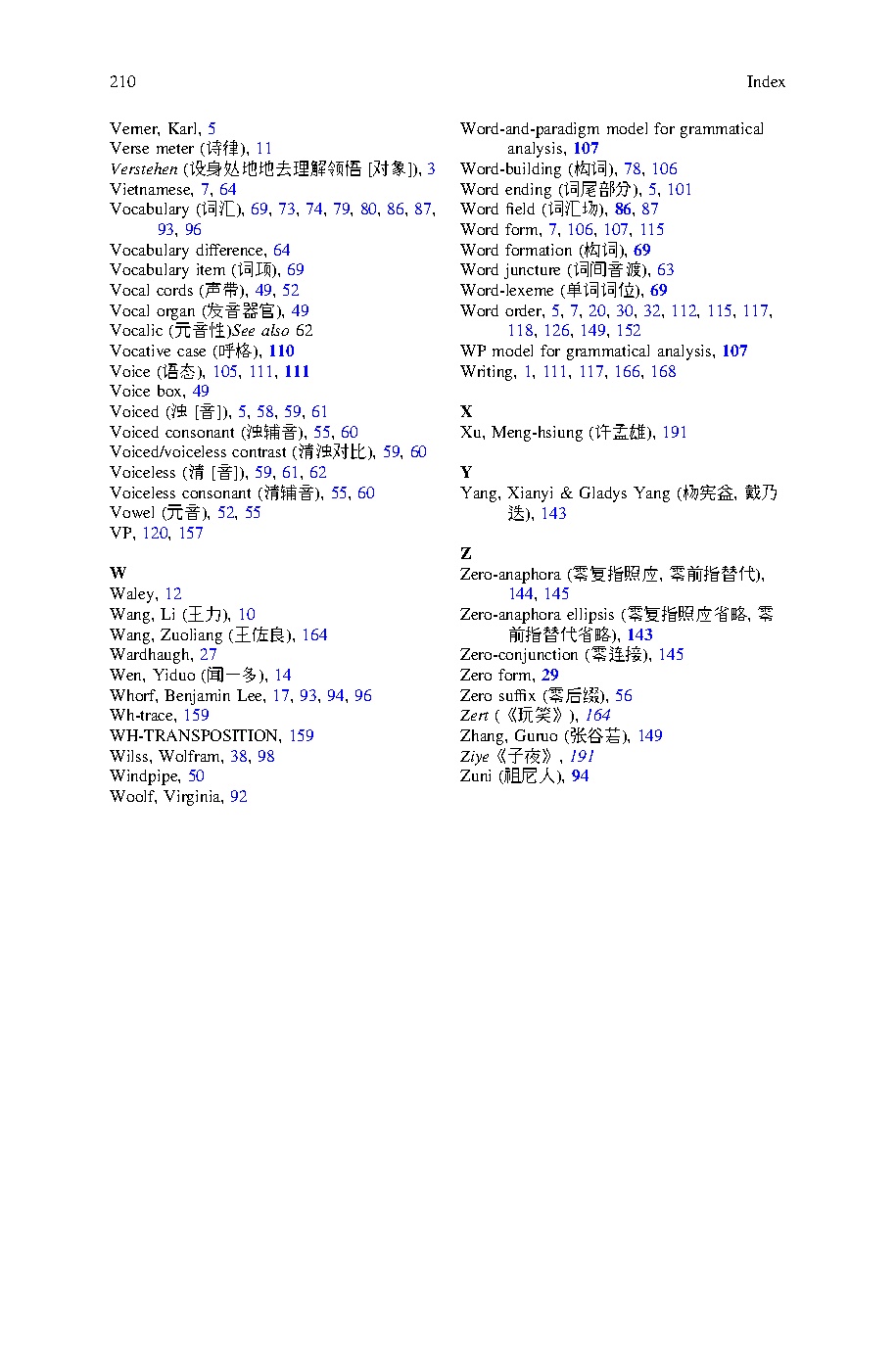
210
Verner, Karl, 5
Verse meter (诗律), 11
Verstehen (设身处地地去理解领悟 [对象]), 3
Vietnamese, 7, 64
Vocabulary (词汇), 69, 73, 74, 79, 80, 86, 87,
93, 96
Vocabulary difference, 64
Vocabulary item (词项), 69
Vocal cords (声带), 49, 52
Vocal organ (发音器官), 49
Vocalic (元音性)See also 62
Vocative case (呼格), 110
Voice (语态), 105, 111, 111
Voice box, 49
Voiced (浊 [音]), 5, 58, 59, 61
Voiced consonant (浊辅音), 55, 60
Voiced/voiceless contrast (清浊对比), 59, 60
Voiceless (清 [音]), 59, 61, 62
Voiceless consonant (清辅音), 55, 60
Vowel (元音), 52, 55
VP, 120, 157
W
Waley, 12
Wang, Li (王力), 10
Wang, Zuoliang (王佐良), 164
Wardhaugh, 27
Wen, Yiduo (闻一多), 14
Whorf, Benjamin Lee, 17, 93, 94, 96
Wh-trace, 159
WH-TRANSPOSITION, 159
Wilss, Wolfram, 38, 98
Windpipe, 50
Woolf, Virginia, 92
Index
Word-and-paradigm model for grammatical
analysis, 107
Word-building (构词), 78, 106
Word ending (词尾部分), 5, 101
Word field (词汇场), 86, 87
Word form, 7, 106, 107, 115
Word formation (构词), 69
Word juncture (词间音渡), 63
Word-lexeme (单词词位), 69
Word order, 5, 7, 20, 30, 32, 112, 115, 117,
118, 126, 149, 152
WP model for grammatical analysis, 107
Writing, 1, 111, 117, 166, 168
X
Xu, Meng-hsiung (许孟雄), 191
Y
Yang, Xianyi & Gladys Yang (杨宪益, 戴乃
迭), 143
Z
Zero-anaphora (零复指照应, 零前指替代),
144, 145
Zero-anaphora ellipsis (零复指照应省略, 零
前指替代省略), 143
Zero-conjunction (零连接), 145
Zero form, 29
Zero suffix (零后缀), 56
Zert (《玩笑》), 164
Zhang, Guruo (张谷若), 149
Ziye《子夜》, 191
Zuni (祖尼人), 94