ASK MOHAWK
465 Saratoga Street Cohoes, New York 12047 1 800 THE MILL mohawkconnects.com
FPO
(Sandy to explore
creating with a
true screen)
Mohawk is North America’s largest privately-owned
manufacturer of fine papers and envelopes which are
preferred for commercial and digital printing, photo
specialties and high-end direct mail. Mohawk fine
papers and envelopes, include the signature brands
Mohawk Superfine® and Strathmore,® as well as
proprietary treatments Inxwell® and i-Tone.® With a
culture of innovation, Mohawk’s business model now
extends beyond paper manufacturing into new areas of
growth, including digital substrates and web-based tools,
which connect designers and printers to new markets.
As a leader in environmentally and socially responsible
business practices, Mohawk was the first U.S.
manufacturer of commercial printing papers to match
100% of its electricity with wind power renewable
energy credits and the first U.S. premium paper mill
to shift toward carbon neutral production. Most of
Mohawk’s portfolio of recycled papers is certified by
Green Seal and the Forest Stewardship Council (FSC).
Mohawk is a fourth-generation, family-owned and
operated business based in Cohoes, New York, with
global sales and operations located throughout North
America, Europe and Asia. For more information,
please visit www.mohawkconnects.com.
76-703820014
July 2015
PRINTING
BASICS
THE
DESIGNER’S
GUIDE TO
ACHIEVING
BRILLIANT
RESULTS ON
UNCOATED
PAPER
FPO
(Sandy to explore
creating with a
true screen)
ASK MOHAWK
Innovations in papermaking,
printing and ink technologies
have made it possible to
deliver beautifully crisp
printed images with the rich
feel of uncoated paper.
Ever-evolving paper and print technology makes it possible to use
premium uncoated papers in exciting new ways. The natural surface of
these papers is a perfect background for four-color process printing. But
it is essential to remember that uncoated papers are absorbent, so inks,
varnishes and coatings perform differently than on coated papers.
Your client has high expectations. Your printer has broad technical
expertise. And you, the designer, are the conduit to bring these two
together. All it takes is communication and attention to detail to
achieve spectacular results.
Expectations differ widely from client to client and printer to printer,
and may even change from project to project. The printer may want
press-ready files or they may want to manage color conversion and
necessary output adjustments in their own controlled environment.
Your job is to navigate these waters with an understanding of how the
printer would like the files prepared and then the files to the
best of your ability. Don’t be afraid to ask questions. Print technology is
constantly improving and changing. Don’t assume that what was status
quo yesterday, is normal operating procedure today.
1 800 THE MILL
1
PRINTING BASICS
COLOR GAMUTS
Modern digital cameras and scanners capture images in the red, green, blue
(RGB) color space. Our computer monitors and televisions display those images
in RGB. In most video displays each pixel is composed of red, green and blue
sub-pixels which combine in various proportions to produce a range of colors.
The colored pixels when viewed from a normal distance appear to blend.
Offset printing requires that those RGB original images be ed to cyan,
magenta, yellow, black (CMYK). Though it varies by the job, ink is typically
applied in the order of the abbreviation. The CMYK model works by applying
ink colors to a lighter, usually white, background. The ink reduces the light that
would otherwise be reflected. This model is called subtractive because inks
subtract brightness from white. A full combination of colored inks results in
black. However, to produce deeper black tones and unsaturated and dark colors
black ink is added.
Like the RGB pixels of your computer monitor, CMYK color is broken down
into dots in offset printing. Our eyes connect the dots to the illusion of
continuous tone and a range of colors.
RGB AND CMYK COLOR GAMUTS
A color gamut, is a subset of colors which can be accurately represented
in a given color space or by a certain output device. Each color space has its
own limitations.
When ing from RGB to CMYK, the original colors which are outside of
the CMYK space gamut must somehow be approximated. Simply trimming the
colors which are out of gamut can seriously hurt the image. Most printers use
profiles to simplify this process. Talk to your printer early to find out how they
want files supplied. Many printers request CMYK press-ready files while others
prefer to make this conversion within their color-controlled environment.
2
MOHAWKCON N EC TS.C OM
THE ADDITIVE PRIMARIES: RED, GREEN AND BLUE.
THE SUBRTRACTIVE PRIMARIES: CYAN,
MAGENTA, YELLOW AND BLACK. IN OFFSET
PRINTING BLACK IS ADDED FOR DEPTH,
CONTRAST AND RICHNESS OF COLOR
CMYK COLOR
GAMUT
RGB COLOR
GAMUT
VISUAL COLOR
GAMUT
1 800 THE MILL
3
PRINTING BASICS
HALFTONES + CMYK
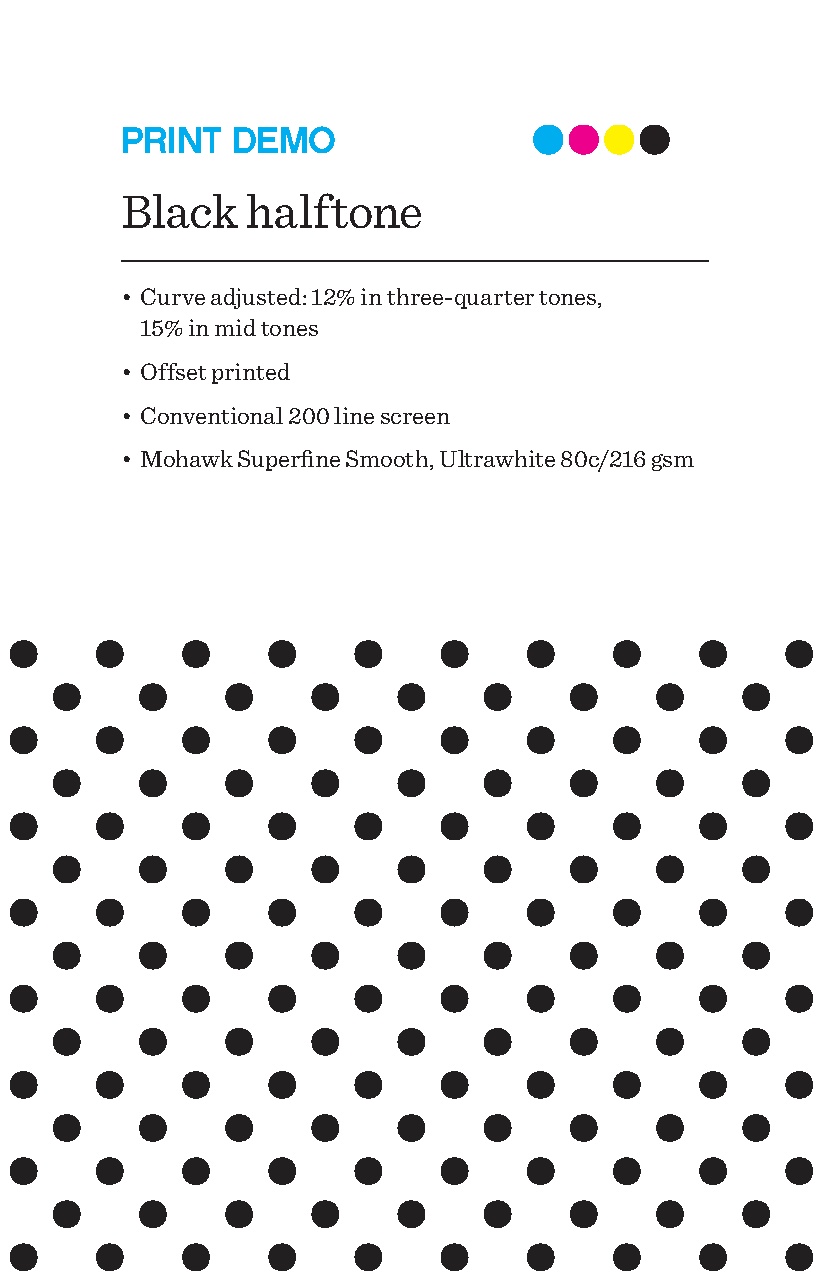
A photograph, painting or illustration that includes different shades or
gradations of color is said to be continuous tone. A halftone is the reprographic
technique that simulates continuous tone imagery through the use of dots,
varying either in size, in shape or in spacing. Where continuous tone imagery
contains an infinite range of colors or grays, the halftone process reduces visual
reproductions to an image that is printed with only one color of ink, in dots of
differing size or spacing.
In printing, ink is applied to the dots but not to the spaces between them. The
size and angle of the screen controls the size and proximity of the dots to
the desired shade. Larger, closer dots darker color because they allow
less of the paper to show through. As dots get smaller and farther apart, the
color gets lighter.
In digital halftoning, images are broken down into dots when printing plates are
made. This process is precise and can produce extremely fine dots, allowing for
many shades and gradations.
Duotones are two color halftones that use two screens at two different angles
and two colors of ink on two different plates to more depth and contrast.
Tritones and quadtones add additional screens at unique angles. All are great
options for jobs where spot colors are used.
CMYK printing uses the four process color inks—cyan, magenta, yellow and
black—to reproduce a broad spectrum of colors and tones and is made possible
by repeating the halftone process for each color. The semi-transparent nature
of ink allows halftone dots to optically reproduce full-color imagery.
HALFTONE
4
DUOTONE
MO HAWKCON N EC TS.C OM
FOUR-COLOR PROCESS
PRINTING BASICS
PIXELS, DOTS + LINES
The history of printing is the history of progress toward reproduction of
continuous tone in mass quantities.
A halftones ability to fool the eye into seeing continuous tone depends on the
size of the screen used to divide the image into dots. The most common method
of creating screens—amplitude modulation or conventional screening—produces
a regular grid of dots that vary in size. The other method of creating screens—
frequency modulation—is used in a process also known as stochastic screening.
The resolution of a conventional halftone screen is measured in lines per inch
(lpi). This is the number of lines of dots in one inch, measured parallel with the
screen’s angle. Screens range from 60 lpi to 600 lpi. The higher the number,
the finer the resolution of detail in the image. Coarser screen in the 60-85 lpi
range have been commonly used in newspapers. For high-quality printing on
premium paper, 175 lpi is considered the minimum standard line screen and
high-quality ultraviolet (UV) printing can print as high as 300 lpi. (Read more
about this on page 10.)
—
Note: Images are measured in pixels per inch (ppi). The higher the resolution
of your image, the greater the detail that can be reproduced. Your image’s pixel
resolution should be twice your intended line screen or a standard 300 ppi.
—
In stochastic printing, uniformly-sized dots are placed randomly. So the density
of a color is determined by the number of dots instead of the size of the dots.
Stochastic screens are measured in microns and refer to the size of the dot. The
lower the number of microns, the finer the resolution of the image. The random
dot pattern of Stochastic screening eliminates rosettes and the potential for
moiré patterns forming. It also offers a broader possible color gamut and
therefore may require different curves.
All screening technologies have tradeoffs. For instance, stochastic can be used
to smooth out screens and maintain consistency but it may not be the best
choice for the imagery or ink coverage in your project. Consult your printer to
determine which screening method is appropriate for your project.
—
Note: Sometimes misused, the term dots per inch (dpi), refers to the imaging of
your computer monitor or printer.
1 800 THE MILL
5
IMAGE RESOLUTION
72 PPI IMAGE FILE
300 PPI IMAGE FILE
IMAGES ARE MEASURED IN PIXELS PER INCH. THE HIGHER THE RESOLUTION OF YOUR IMAGES, THE GREATER THE DETAIL THAT CAN BE REPRODUCED. YOUR IMAGES PIXEL RESOLUTION SHOULD BE TWICE YOUR INTENDED LINE SCREEN OR A STANDARD 300 PPI.
LINE SCREEN
THE RESOLUTION OF A CONVENTIONAL HALFTONE SCREEN IS MEASURED IN LINES PER INCH (LPI). THIS IS THE NUMBER OF LINES OF DOTS
IN ONE INCH, MEASURED PARALLEL WITH THE SCREEN’S ANGLE. HERE A TONE OF THE SAME VALUE IS REPRESENTED BY INCREASINGLY
FINER LINE SCREENS.
60 LPI
150 LPI
60 LPI
200 LPI
THE SAME IMAGE IS SHOWN AT COARSE LINE SCREEN, SIMILAR TO A NEWSPAPER (ON THE LEFT), AND THEN AT A STANDARD OFFSET LINE
SCREEN (ON THE RIGHT).
6
MOHAWKCON N EC TS.C OM
CONVENTIONAL LINE SCREEN ANGLES AND THE
RESULTING ROSETTE PATTERN. (YELLOW AT 0°, BLACK
AT 45°, CYAN AT 15° AND MAGENTA AT 75°.)
STOCHASTIC SCREEN (REPRESENTATION)
SCREEN COMPARISONS
60 LPI CONVENTIONAL
35 MICRON STO