The production team
The close integration of text, translation and graphics in this book called for
an equally close collaboration between the author, translator and designer.
Only through intensive teamwork, from conception to production, has this
book, in its present form, been possible.
Jan-Peter Homann (b. 1964)
studied Communication Science and Technology at the TU Berlin, Germany.
Since 1988 he has been working in image editing, color management and
pre-press. Since 1991 he has been writing for publications such as PAGE and
Publishing Praxis. In 1989 he published his first book: “Digitalisieren mit
Amiga” (Digitizing with Amiga).
Homann
Axel Raidt (b. 1969)
is a skilled typographer, studied Communications Design at the FHTW Berlin
and works as a freelance graphic designer, mainly in corporate and editorial
design. He is responsible for the design and layout of this book as well as
the graphics.
Raidt
Andy Jack-Newman (b. 1970)
studied Visual Communication at the University of Portsmouth, England.
From 1991 he worked in Berlin as both a graphic designer and translator.
Since 2007 he has been working as a senior web designer on the south
coast of England.
Jack-Newman
Jan-Peter Homann
Digital
Color Management
Principles and Strategies for the
Standardized Print Production
Jan-Peter Homann
Christinenstraße 21, 10119 Berlin, Germany
www.colormanagement.de
ISBN 978-3-540-67119-0
e-ISBN 978-3-540-69377-2
DOI 10.1007/978-3-540-69377-2
ISSN 1612-1449
Library of Congress Control Number: 2008932552
© 2009 Springer-Verlag Berlin Heidelberg
Title of the original German edition:
Digitales Colormanagement, 3rd edition
ISBN 978-3-540-20969-0, © Springer-Verlag 1998, 2000, 2007
This work is subject to copyright. All rights are reserved, whether the whole or part of the
material is concerned, specifically the rights of translation, reprinting, reuse of illustrations,
recitation, broading, reproduction on microfilm or in any other way, and storage in data
banks. Duplication of this publication or parts thereof is permitted only under the provisions
of the German Copyright Law of September 9, 1965, in its current version, and permission for
use must always be obtained from Springer. Violations are liable to prosecution under the
German Copyright Law.
The use of general deive names, registered names, trademarks, etc. in this publication
does not imply, even in the absence of a specific statement, that such names are exempt from
the relevant protective laws and regulations and therefore free for general use.
Translated from the German by Andrew Jack-Newman
Layout and design: Axel Raidt, Berlin
Production: le-tex publishing services oHG, Leipzig
Cover design: KünkelLopka, Heidelberg
Printed on acid-free paper
9 8 7 6 5 4 3 2 1
springer.com
Contents
1998: Introduction from the first German Edition . . . . . . . . . . . . . . . . . . . 9
Digital Color Management – a Didactic Play in 7 Chapters . . . . . . . . . . . 15
Chapter 1: Color Theory with Ideal Colors . . . . . . . . . . . . . . . . . . . . . . . 17
The Spectrum and the Eye . . . . . . . . . . . . . . . . . . . . . . . . . . . . . . . . . . . . . 18
Ideal Colors and Ideal Cones . . . . . . . . . . . . . . . . . . . . . . . . . . . . . . . . . . . 20
Additive and Subtractive Color Models with Ideal Colors . . . . . . . . . . . . 22
Hues in the Cube . . . . . . . . . . . . . . . . . . . . . . . . . . . . . . . . . . . . . . . . . . . . 26
The Levels of Equal Lightness in the Cube . . . . . . . . . . . . . . . . . . . . . . . . 28
The Areas of Equal Saturation in the Cube . . . . . . . . . . . . . . . . . . . . . . . . 30
Chapter 2: Color Theory with Realistic Colors . . . . . . . . . . . . . . . . . . . . 33
The Limitations of the Cube with Ideal Colors . . . . . . . . . . . . . . . . . . . . . 34
The Expanded Model of Vision . . . . . . . . . . . . . . . . . . . . . . . . . . . . . . . . . . 36
The LCH Color Space . . . . . . . . . . . . . . . . . . . . . . . . . . . . . . . . . . . . . . . . . . 38
Similarities between the LCH Color Space and the Cube . . . . . . . . . . . . 40
Differences between the LCH Color Space and the Cube . . . . . . . . . . . . 42
From LCH to the Lab Color Space . . . . . . . . . . . . . . . . . . . . . . . . . . . . . . . . 44
Color Saturation in the LCH/Lab Color Spaces . . . . . . . . . . . . . . . . . . . . . 46
Lightness in the LCH/Lab Color Spaces . . . . . . . . . . . . . . . . . . . . . . . . . . 50
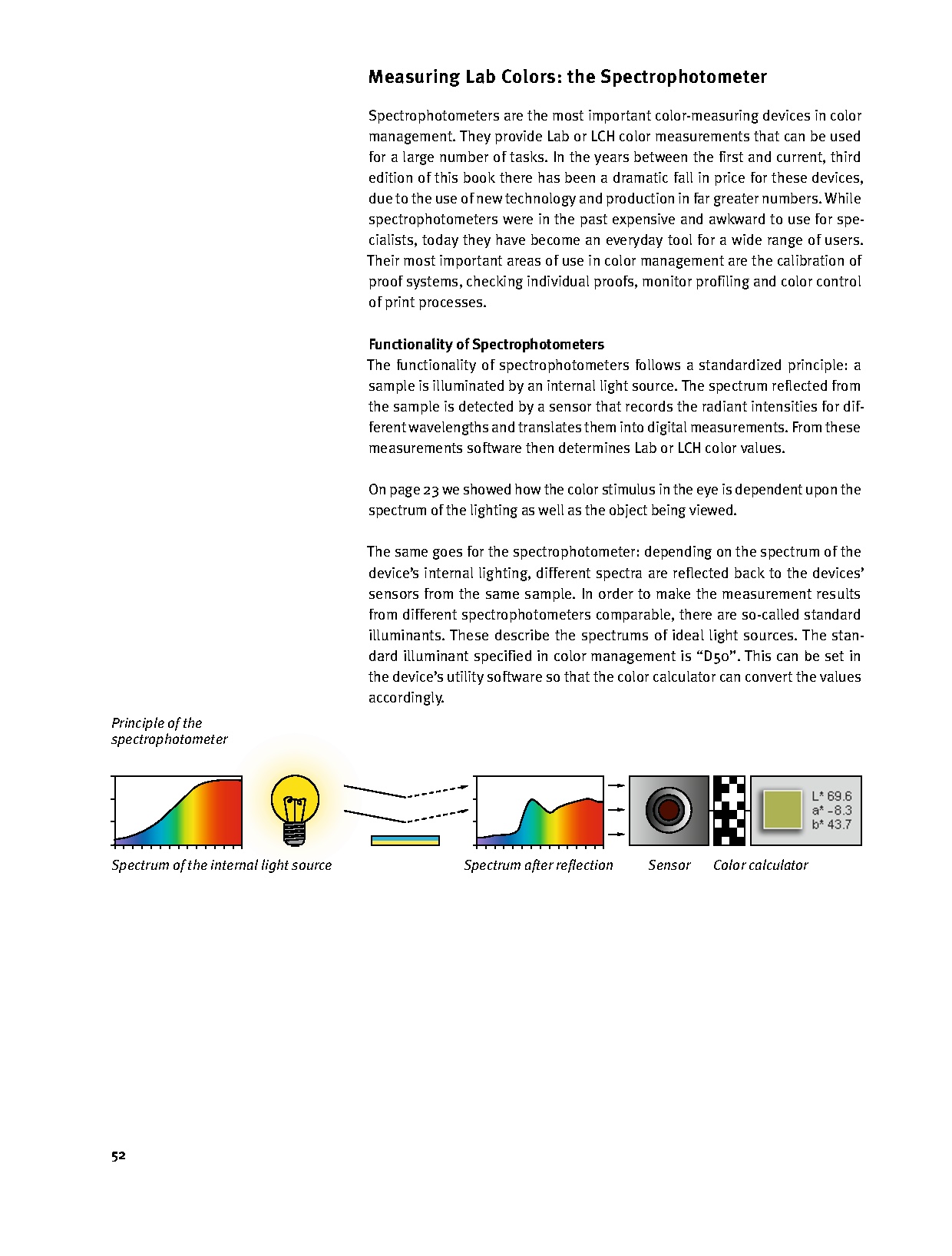
Measuring Lab Colors: the Spectrophotometer . . . . . . . . . . . . . . . . . . . . 52
Practical Applications of the Lab Color Space . . . . . . . . . . . . . . . . . . . . . 54
Lab Measurements of Paper with Optical Brighteners . . . . . . . . . . . . . . 56
Lab Values of Typical Paper in Color Management . . . . . . . . . . . . . . . . . 57
Chapter 3: The Principles of Color Management . . . . . . . . . . . . . . . . . . 59
The Workflow from Contract to Print . . . . . . . . . . . . . . . . . . . . . . . . . . . . . 60
Profiling Scanners and Digital Cameras . . . . . . . . . . . . . . . . . . . . . . . . . . 62
Profiling Monitors . . . . . . . . . . . . . . . . . . . . . . . . . . . . . . . . . . . . . . . . . . . . 63
Characterizing and Profiling Printing Processes . . . . . . . . . . . . . . . . . . . 64
Standard Profiles for Offset Printing and Proof Systems . . . . . . . . . . . . 65
Color Conversion with Color Profiles . . . . . . . . . . . . . . . . . . . . . . . . . . . . 66
Color-accurate Work with CMYK Data . . . . . . . . . . . . . . . . . . . . . . . . . . . . 67
Simple Workflow with CMYK Data . . . . . . . . . . . . . . . . . . . . . . . . . . . . . . . 69
Color Management with RGB Data . . . . . . . . . . . . . . . . . . . . . . . . . . . . . . 70
Color Management with Embedded Profiles . . . . . . . . . . . . . . . . . . . . . . 71
Division of Work and Communication . . . . . . . . . . . . . . . . . . . . . . . . . . . . 72
Papers with Optical Brighteners in the Profile Chain . . . . . . . . . . . . . . . 75
Chapter 4: ISO 12647/GRACoL/SWOP for Separation, Proof and Print . . . 77
The Role of ISO Standards . . . . . . . . . . . . . . . . . . . . . . . . . . . . . . . . . . . . . 78
An Overview of Tools for ISO 12647 Implementation . . . . . . . . . . . . . . . 80
Profiles from Adobe or ECI in the Production Process . . . . . . . . . . . . . . . 81
The Media Wedge CMYK in the Production Process . . . . . . . . . . . . . . . . . 82
The Application of the Altona Test Suite . . . . . . . . . . . . . . . . . . . . . . . . . . 83
The Color Reproduction of Different ISO Paper Types . . . . . . . . . . . . . . . 84
Ink-layer and Solid Densities . . . . . . . . . . . . . . . . . . . . . . . . . . . . . . . . . . . 85
Dot Gain /TVI of Paper Types . . . . . . . . . . . . . . . . . . . . . . . . . . . . . . . . . . . 86
Dot Gain /TVI of Paper Types According to ISO 12647-2 . . . . . . . . . . . . . 87
Screen tint in print (%)
100
CMY NPDC
1.6
91
80
60
53
40
20
20
40
60
80
100
Screen tint in the file (%)
The Gray Balance . . . . . . . . . . . . . . . . . . . . . . . . . . . . . . . . . . . . . . . . . . . . 88
The Lab Coloration of the Solids in ISO 12647 . . . . . . . . . . . . . . . . . . . . . 89
Guidelines, Manuals and Brochures Referring to ISO 12647 . . . . . . . . . 90
Standards in Reproduction . . . . . . . . . . . . . . . . . . . . . . . . . . . . . . . . . . . . . 91
TAC and Black Generation . . . . . . . . . . . . . . . . . . . . . . . . . . . . . . . . . . . . . . 92
The Relationship of Black to Cyan, Magenta and Yellow . . . . . . . . . . . . . 94
UCR and GCR . . . . . . . . . . . . . . . . . . . . . . . . . . . . . . . . . . . . . . . . . . . . . . . . 95
UCR and GCR: the Significance of Paper Color . . . . . . . . . . . . . . . . . . . . . 96
UCR and GCR in Different Programs . . . . . . . . . . . . . . . . . . . . . . . . . . . . . . 98
Black Generation in the ECI Profiles . . . . . . . . . . . . . . . . . . . . . . . . . . . . . . 99
Standard Profiles for Gravure, Continuous Form and Newsprint . . . . . 100
The History of FOGRA39 . . . . . . . . . . . . . . . . . . . . . . . . . . . . . . . . . . . . . . 101
The Latest from the USA: GRACoL, SWOP and G7 . . . . . . . . . . . . . . . . . 102
Digital Proofing According to GRACoL and SWOP . . . . . . . . . . . . . . . . . 103
The GRACoL/SWOP Profiles in the Production Workflow . . . . . . . . . . . . 104
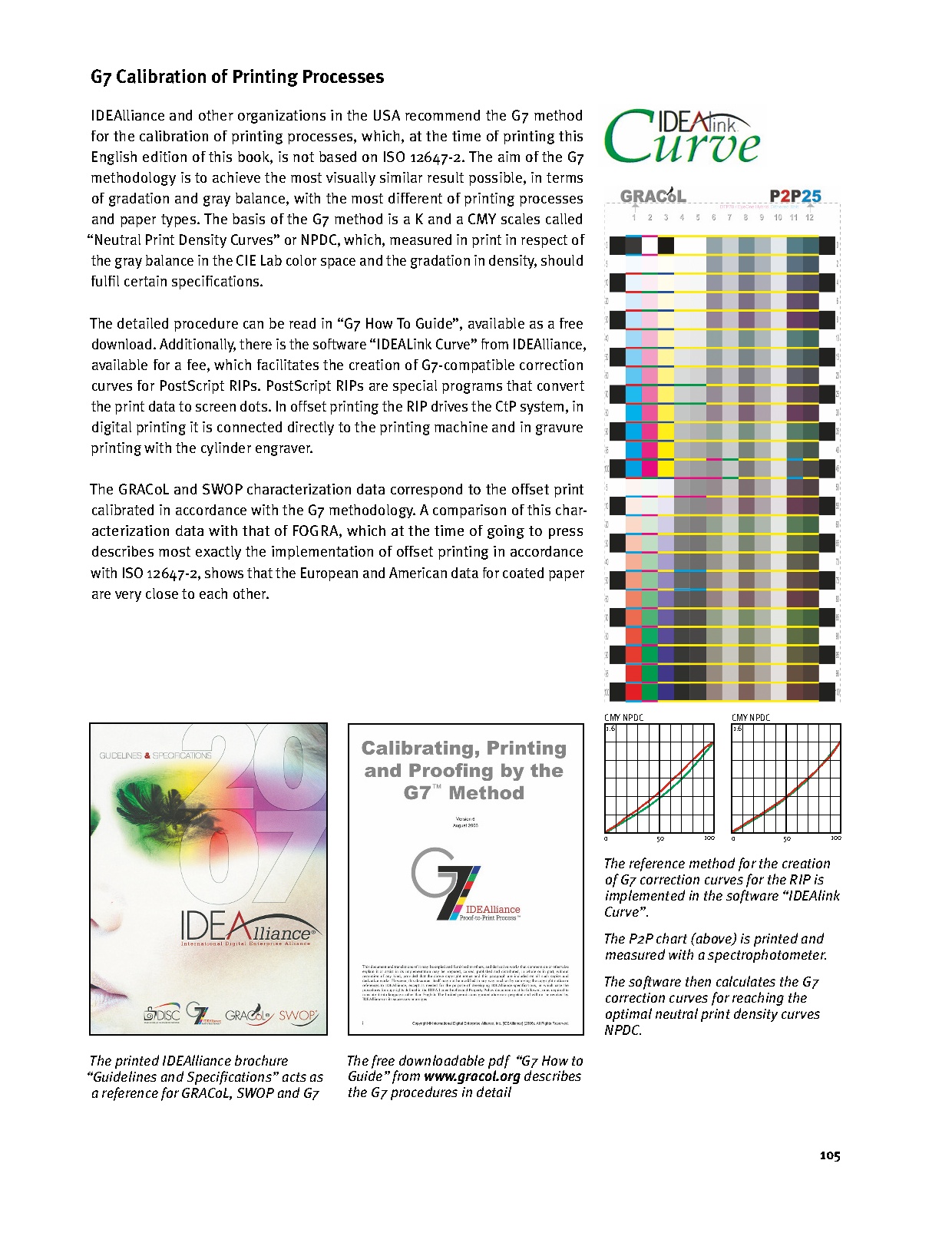
G7 Calibration of Printing Processes . . . . . . . . . . . . . . . . . . . . . . . . . . . 105
FOGRA/ISO 12647-2 versus G7 . . . . . . . . . . . . . . . . . . . . . . . . . . . . . . . . 106
Discussions in ISO TC 130 about G7 . . . . . . . . . . . . . . . . . . . . . . . . . . . . 107
Optical Brighteners in Production According to Print Standards . . . . 108
ICC color management
Graphics/Repro
Printer
Chapter 5: Using ICC Strengths and Avoiding ICC Problems . . . . . . 111
In the Past: Hard Facts about Data Transfer . . . . . . . . . . . . . . . . . . . . . . 112
Today: Uncertainty and Unclear Responsibilities . . . . . . . . . . . . . . . . . . 113
ICC Standard, the Trouble Maker . . . . . . . . . . . . . . . . . . . . . . . . . . . . . . . 114
A Short Look Back at the Development of the ICC Standard . . . . . . . . 115
The Successes of the ICC Standard . . . . . . . . . . . . . . . . . . . . . . . . . . . . . 117
Missing ICC Definitions for Processes and Test Files . . . . . . . . . . . . . . . 118
No ICC Parameters for the Proof of RGB Data . . . . . . . . . . . . . . . . . . . . . 119
The Myth of Mixed-color Documents . . . . . . . . . . . . . . . . . . . . . . . . . . . 120
Consequences for the Following Sections . . . . . . . . . . . . . . . . . . . . . . . 121
The Role of the RGB Working Color Space . . . . . . . . . . . . . . . . . . . . . . . . 122
ICC-based Workflows and the World of sRGB . . . . . . . . . . . . . . . . . . . . . 124
PhotoG